









YEMA x Alain Silberstein Limited Edition Watch Review

The first time this watch shows up in a room, it doesn’t ask permission. There’s a flash of primary color, a set of shapes that look more like a sketchbook experiment than a piece of gear, and a split second where your brain files it under “object” before it ever lands on “instrument.” It’s the kind of first impression that makes you wonder if you’re looking at a serious dive watch or a very confident piece of design theater.
Living with the YEMA x Alain Silberstein Limited Edition (ref. 20.24.66.TN.U6) for a stretch made the intent clearer. This is a contemporary luxury collaboration that tries to do both sides of its personality at full volume: French manufacture credibility and artist-driven form. It mostly works, and when it doesn’t, the friction is the same thing that makes it compelling.
A Collaboration With Teeth

Some collaborations feel like a logo swap and a press release. This one feels authored. Alain Silberstein’s fingerprints are everywhere, from the geometric hands to a case that’s been designed from scratch and engineered as a complex, multi-part construction. The design language is openly modernist, tied to the Bauhaus school and the kind of abstract-art lineage that gets namechecked with Kandinsky, Picasso, and Miró. You can sense that even if you never read a word about it. The shapes do the talking.
What surprised me, wearing it day to day, is how quickly the visual novelty stops being the headline. The boldness becomes the interface. The bright red hour hand, the yellow minute hand, the blue seconds hand shaped like a sea star: it’s playful, but not random. It’s a system.
The dual-crown layout also signals intent beyond styling. YEMA frames it as symmetrical and vintage-inspired, but in practice it’s more like a statement of order. Two crowns, two jobs, no ambiguity in what the watch wants to be. It’s not “art slapped onto a watch.” It’s art that’s been forced to negotiate with watchmaking.
Casework That Refuses to Phone It In
Most watches that want attention lean on polishing and reflections. Here, the attention comes from geometry and finish choices that keep things matte and modern. The 40 mm case is Grade 5 titanium with a DLC coating, microblasted so it absorbs light instead of throwing it back. On the wrist it reads stealthy, almost technical, which makes the dial’s color feel even more deliberate.

The crowns are where the architecture becomes functional. Both are Grade 5 titanium and both are screw-down, with the upper crown treated with a blue Cerakote ceramic coating. That upper crown controls an internal rotating dive bezel, which is a detail I ended up appreciating more than I expected. External bezels can feel performative if you’re not timing anything serious. An internal bezel, set through a crown, feels more like part of the watch’s design grammar.
The lugs are also a quiet flex. They’re described as an integral part of the caseback, and you can feel that continuity when you handle it. There’s a seamlessness where the strap meets the case that makes the whole thing look engineered rather than assembled. Even before you flip it over, it has that satisfying sense of a product that was designed as one piece.
Wearing the Geometry

If you want a rare watch for rarity’s sake, this is limited in a way that’s clear and concrete: 500 pieces total, with a unique Limited Edition number engraved on each caseback. Mine became a small ritual early on, flipping the watch over on the first night just to see that numbering and confirm, yes, this is part of a finite run and not a “limited” label that never ends.
On the wrist, 40 mm in lightweight titanium is an easy size to live with. The microblasted DLC surface doesn’t grab attention through shine, so the watch wears more quietly than the dial suggests, at least at arm’s length. Up close, it’s all character. From across a table, it’s mostly a black watch with flashes of primary color when your wrist moves.

YEMA includes two premium FKM rubber straps, one black and one red, both paired with a Grade 5 titanium deployant clasp with a black DLC microblasted finish. I started with black because it frames the dial and makes the whole watch feel sharper, then swapped to red later when I wanted the design to stop pretending it could be subtle. The deployant clasp feels like the correct choice here, not an afterthought.
One small reality: the dual crowns add presence at the case sides. Not a dealbreaker, but you feel the architecture in a way a single-crown watch doesn’t ask you to.
Two Crowns, Zero Confusion

This watch has a learning curve, but it’s a clean one. The lower screw-down crown handles time-setting and winding. The upper screw-down crown operates the internal rotating dive bezel. That sounds obvious written out, but in the first few days my muscle memory still went to the wrong crown once or twice, especially when I was moving quickly. After a week, it became automatic.
Unscrewing and re-securing two crowns is part of the rhythm. It’s also part of why the watch feels serious about its water resistance. The sapphire exhibition caseback is stated to preserve water resistance of 20 BAR (200 m), and the screw-down system matches that posture. I didn’t baby it in day-to-day life. Hand washing, getting caught in rain, general desk life. The crowns stayed smooth to operate, and the threads never felt finicky.
The “service” side of the product is mostly policy and presentation, but it matters at this price. The watch arrives in an elegant collector’s case with a personalized International Warranty card. YEMA backs mechanical manufacture movements with a 5-year international warranty. There’s also the YEMA Privilege loyalty program tied to a first purchase, including free shipping, 24/7 customer service, and tiered offers. I didn’t need to test customer service to feel the point: they’re trying to remove friction from the buying side in a way that matches the watch’s confident positioning.
Night Vision With an Accent

In daylight, the dial works because it’s structured. The black base keeps things grounded, and the hands are distinct enough that your eye separates them quickly once you’ve spent a little time with the shapes. The markers help more than you expect. They’re three-dimensional applied blocks fully coated in Super-LumiNova, rising above the dial surface like small architectural elements.
At night, those markers become the whole story. YEMA uses a patented 3D process: Super-LumiNova poured into polyester micro-moulds to create small blocks, with more volume meant to emit more light. In real use, it does what you want it to do. After charging it under a bright light and then checking time later in a dark room, the markers stayed readable, and the watch kept that “quick glance” function intact.
The hands are where the design asks something of you. The stylized geometry looks great, but it can take an extra beat to read compared to more traditional handsets, especially when you’re tired and checking the time in low light. It’s not confusion so much as translation. Once you’ve lived with the red triangle hour hand and the yellow arrow minute hand, you stop thinking about it. The first few nights, I did think about it.
What I liked most is that the lume and the color aren’t fighting. The watch stays itself in the dark. It doesn’t turn into a generic glowing circle.
When the Movement Steals the Show

This is where the collaboration earns its luxury pricing. The watch uses YEMA’s CMM.20 Calibre Manufacture Morteau 20, a micro-rotor mechanical movement designed, manufactured, assembled, and calibrated by YEMA’s watchmakers in their Morteau workshops in France. Micro-rotor architecture is one of those choices that signals intent. It’s not just “automatic,” it’s a specific type of automatic with a design payoff: an ultra-thin architecture that enables sleeker, thinner watch cases.
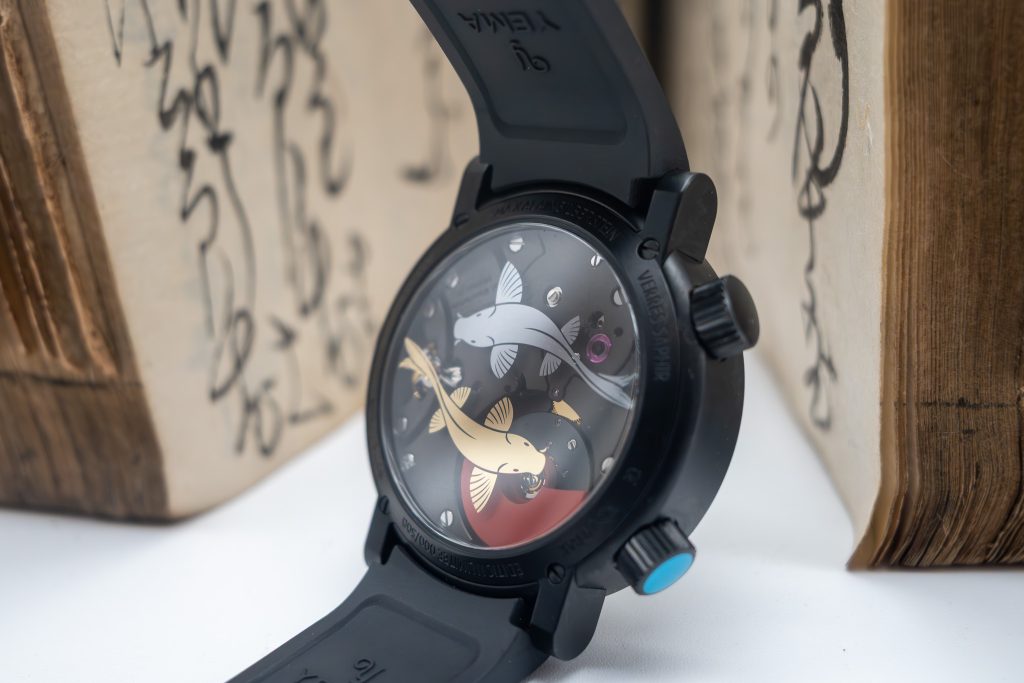
The movement is self-winding with a tungsten micro-rotor, and through the sapphire exhibition caseback you can actually watch it do its job. The bridges are black galvanic decorated and the oscillating weight is red, which feels perfectly aligned with Silberstein’s color-first worldview. I caught myself flipping the watch over more than once during a workday, just to see the rotor swing as I moved. It’s a mechanical fidget toy in the best way.
There’s also a koi motif printed under the sapphire caseback, described as symbolism for traits like bravery and perseverance. Call it romantic, call it marketing, but it gives the back of the watch an emotional temperature. A lot of exhibition casebacks are technically interesting and spiritually empty. This one has a point of view.
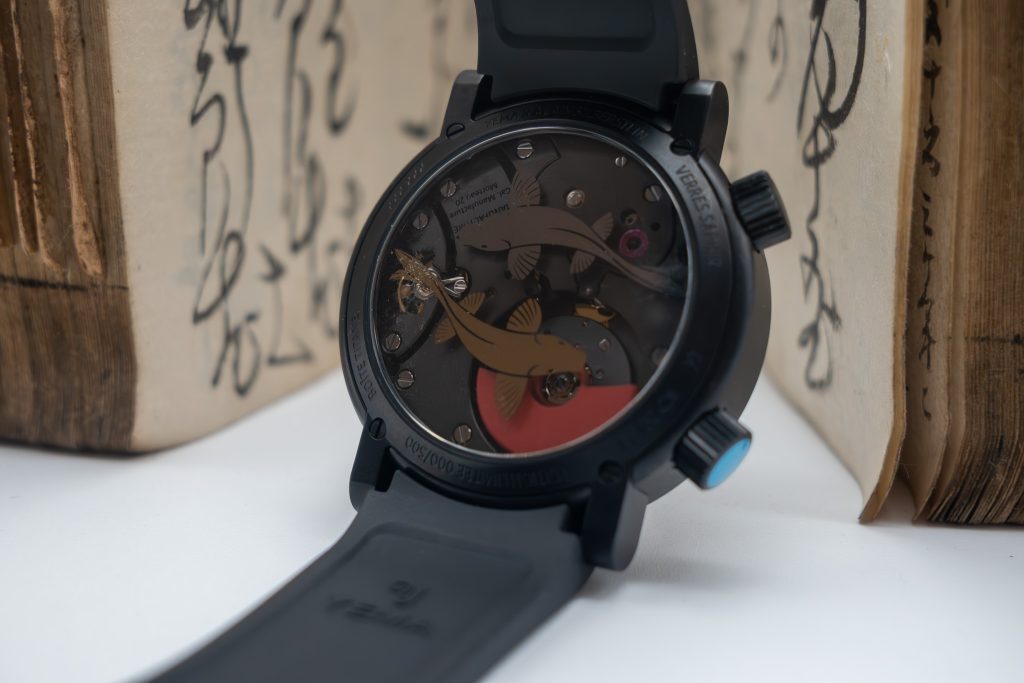
Performance is stated with unusual clarity: 28,800 A/h, approximately 70 hours of power reserve, and a daily rate of -3/+7 seconds per day, positioned as near chronometric performance. Over several days of checking it against my phone, it behaved like a watch that’s been regulated with care. YEMA also describes high resistance to magnetic fields and shocks, without getting dragged into standards talk.
The internal rotating dive bezel, controlled by the upper crown, rounds out the feature set with something practical that doesn’t clutter the dial. It’s a tool feature that still respects the design.
Limited Edition, Daily Watch
At $4,390.00 on YEMA’s official site, this watch lives in a part of the market where buyers start asking uncomfortable questions. What am I paying for: design, movement, scarcity, or story? Here, you’re paying for a blend that’s hard to fake.

The limited edition positioning is real. Five hundred pieces, each engraved with its own number. It’s also presented as a one-time limited edition. When I checked in on availability, it was marked LOW STOCK with the last 20 timepieces remaining before sold out. That kind of end-of-run moment does two things: it adds urgency, and it also forces honesty. If you love it, waiting is its own decision.
Value is helped by what’s included. Two premium FKM rubber straps, black and red, both with a titanium deployant clasp in a matching black DLC microblasted finish. The collector’s case and personalized warranty card make the whole thing feel like a considered package, not a bare watch in a generic box. The 5-year international warranty on mechanical manufacture movements matters too, especially for anyone buying into a brand’s in-house ambitions.
YEMA also positions its production with a regional logic: significant insourcing in Morteau, modernization of workshops, and sourcing non-movement components from Switzerland within roughly a 70-72 km radius. I like that they’re specific about the geography, because vague “Swiss parts” language doesn’t mean much anymore.
Final Thoughts
 The YEMA x Alain Silberstein Limited Edition is the rare design-forward watch that doesn’t feel like it’s hiding behind design. The case is Grade 5 titanium with a DLC microblasted finish that reads modern and durable. The dual-crown setup is more than visual symmetry, it’s a functional layout that makes the internal dive bezel feel integrated instead of bolted on. And the dial, loud as it is, has an internal logic that holds up when you’re actually living with it.
Buy it if you want an independent-leaning collaboration with real manufacture ambition, anchored by the CMM.20 micro-rotor movement and backed by a 5-year warranty. It’s for collectors who are comfortable wearing a watch that looks like nothing else in the room, and who care that the engineering matches the attitude.
Skip it if you want traditional luxury codes, instant at-a-glance legibility without learning the handset, or a watch that disappears under a cuff. This one doesn’t disappear. That’s the point.
The moment that stuck with me came late in the run, taking it off at the end of a long day and catching the red rotor swinging under sapphire, with that koi motif sitting quietly beneath it. Art on the front, mechanics on the back, and neither side feels like a compromise.