








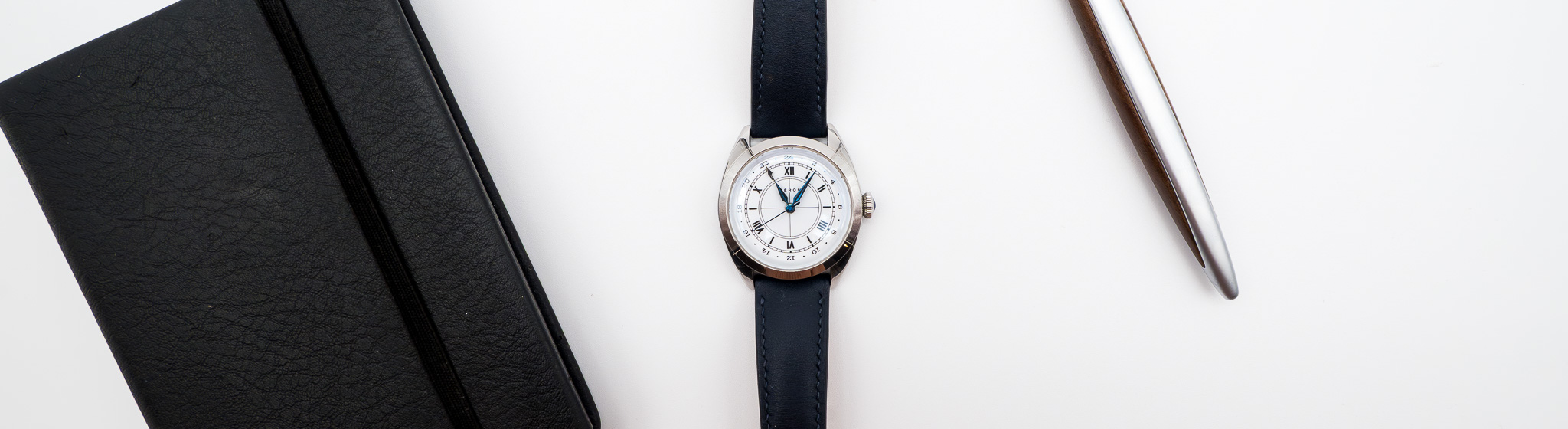
Héron Mirabel GMT Watch Review

The first thing that mattered wasn’t the second time zone or the spec sheet; it was how the watch behaved in that in-between light where most pieces fall apart. In my hands, the Héron Mirabel GMT (white dial, REF. 4002-A) felt like an object designed by someone who cares about proportion and the small rituals of use: winding, setting, checking the time in a doorway where sun breaks into shade.
Héron describes the Mirabel GMT as a dress watch that can track two time zones, with inspiration drawn from classic aviation and military tool watches. That’s a familiar pitch. The harder part is delivering substance at an accessible price. After living with it through ordinary days, the Mirabel’s strengths became clearer: a considered dial, honest materials, and a GMT implementation that behaves like a tool, even when dressed for dinner.
Montréal Roots, Measured Nostalgia
Héron is based in Montréal, and the Mirabel GMT carries that particular kind of modern affection for old forms: not costume, not parody, but a deliberate reconstruction of the cues we’ve learned to trust. The collection itself makes the intent plain. There are at least five variants, including White (REF. 4002-A), Brown (REF. 4003), Blue (REF. 4004-A), Black (REF. 4001-A), and the Cigar Club edition (REF. 4201-A). The spread reads like a wardrobe: conservative anchors and one more expressive option.
The Mirabel GMT sits in regular production, with early batches offering individually numbered casebacks for the first series of pieces. It arrives with the watch’s central promise already framed: a neo-vintage dress GMT, positioned as accessible in the sub-$1,000 segment, priced around $690.
Those labels can blur into marketing fog if the object doesn’t hold up to attention. Here, the attention is rewarded quickly. The case is 316L stainless steel, and the design speaks in quiet sentences: a C-shaped case, a boxed sapphire crystal, an enamel painted sector dial. The vocabulary is vintage, but the materials and execution aim for modern clarity.
Light, Enamel, and Blue Steel
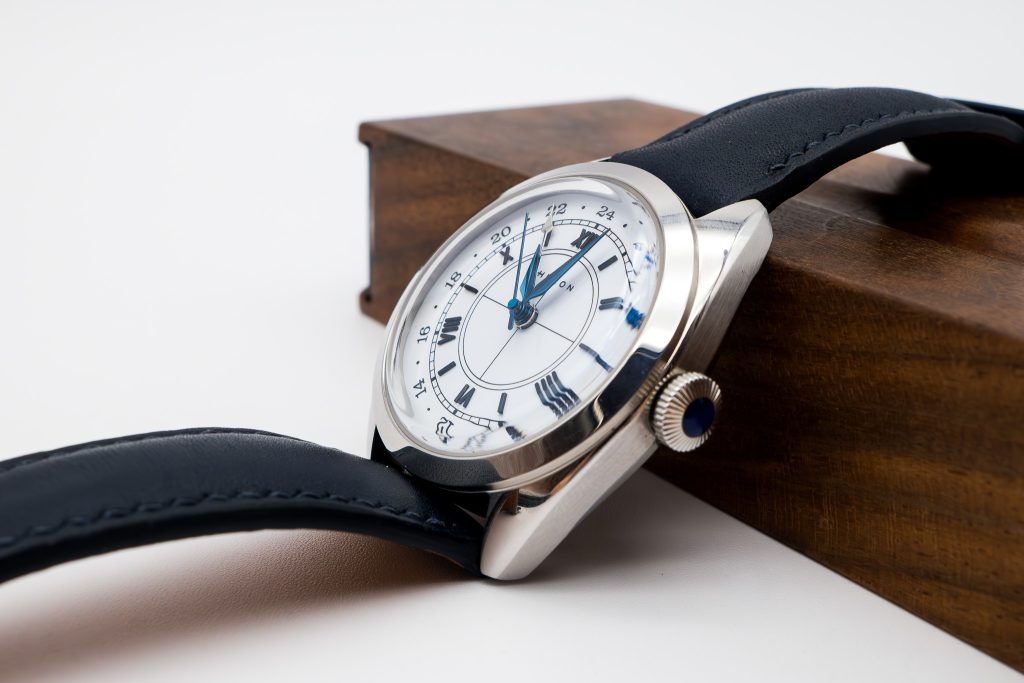
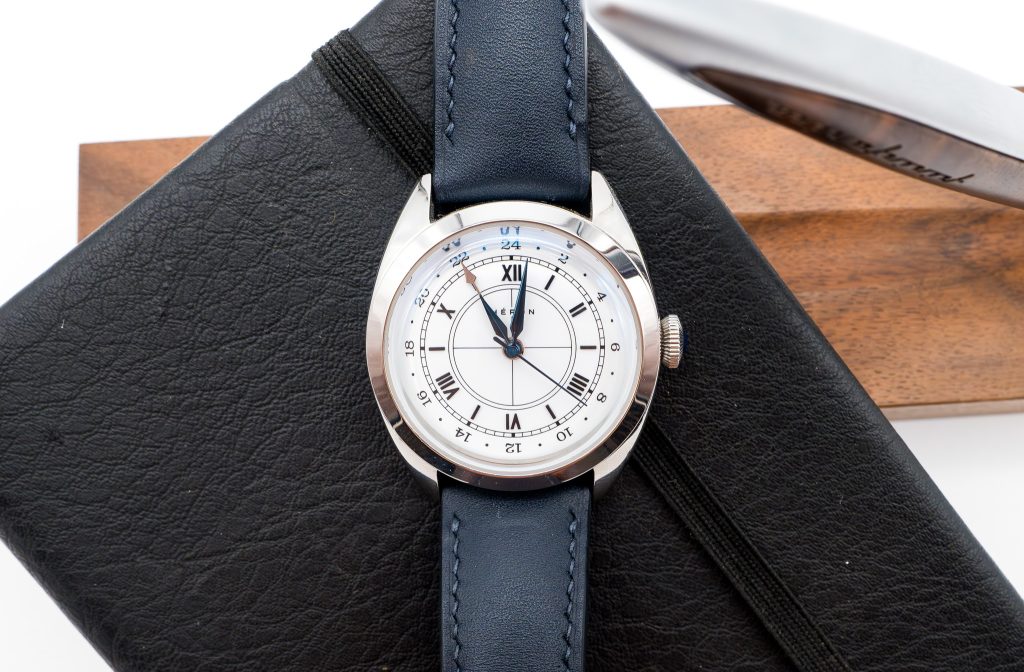
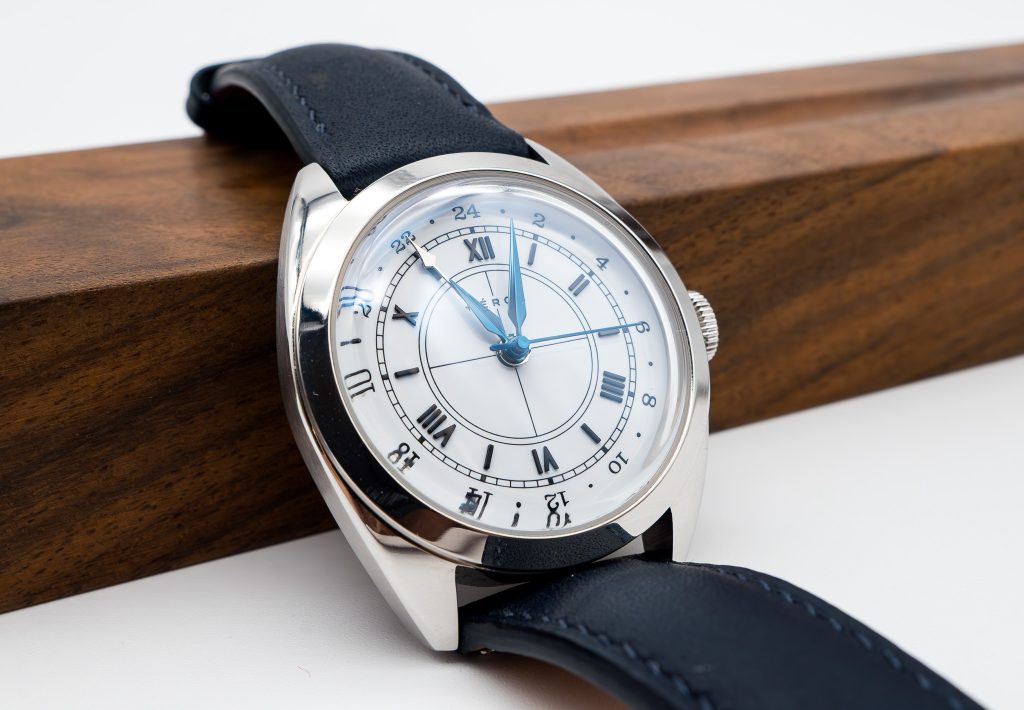
That first morning, I wore it near a window and watched the dial do something that matte paint rarely manages. The Mirabel GMT’s white dial is an enamel painted sector dial, and it reads as carefully layered rather than merely printed. The sector layout gives the face structure, a sense of measured space, like a page with margins. On top of that, polished applied numerals catch light in brief flashes, never shouting, just reminding you the surface has depth.
The hands on this white variant are described as blue heated hands, faceted, with a capped seconds hand. In direct light they shift, not in color so much as in temperament: sometimes ink-dark, sometimes a sharper blue that feels almost metallic. Facets matter here. Flat hands can disappear against a pale dial; these don’t. The seconds hand cap adds a small sense of finish, a tiny punctuation mark at the center that keeps the dial from feeling too austere.
The boxed sapphire crystal, with anti-reflective coating, plays its part. Boxed crystals add height and presence, but they can turn into mirrors. This one behaved well in the ordinary situations that expose glare: overhead lighting at a desk, afternoon sun angled low, the brief shock of brightness when you step outside. Reflections never vanished, because they never do, but they stayed manageable, allowing the enamel and applied markers to remain the point.
Proportions with an Opinion
Dress watches often promise discretion and then arrive oversized, thickened by the compromises of modern life. The Mirabel GMT is more disciplined: 37.5 mm in diameter, 43.5 mm lug-to-lug, with thickness listed at 10.6 mm, or 11.8 mm including the boxed crystal. The lug width is 20 mm. On paper, those numbers suggest balance. On the wrist, the balance mostly holds.
The C-shaped 316L case wears with a kind of softened geometry. It doesn’t feel sharp or aggressive, and the shorter lug-to-lug helps the watch sit neatly rather than stretching beyond the wrist’s natural curve. Under a cuff, it behaves like a dress piece for most of the day. Still, I kept noticing the vertical presence created by the boxed crystal. That 11.8 mm total thickness reads differently from a flatter dress watch, especially from the side. It isn’t ungainly, but it’s present, and that presence is part of the watch’s character.
Over successive wearings, the proportions became more convincing. The dial has enough detail to justify the case’s visual height. The watch feels like a refined instrument rather than a fragile formality, which suits a GMT complication. It’s a dress watch, yes, but not a disappearing one.
GMT for People Who Actually Travel
A GMT can be a party trick, or it can be a working feature that quietly improves your day. The Mirabel GMT uses an automatic “True GMT” Miyota 9075 movement, which means it doesn’t require a battery and is built for the practical act of tracking two time zones. The movement is widely described with 24 jewels, a 28,800 bph beat rate, and about 42 hours of power reserve.
What matters more than those familiar lines is how it behaves when you’re tired, when you’re traveling, when you don’t want to think. Héron provides instructions for setting the Miyota 9075 GMT feature, and I did what most owners do: I looked them up the first time, crown in hand, not wanting to guess and misalign the story the hands were trying to tell.
Once set, the utility settles in. The GMT hand gives you a second reference without turning the dial into a puzzle, and against the white sector layout it remained legible in changing light. I used it as a steady anchor for a second time zone through my usual days, checking it in small moments rather than ceremonially.

Power reserve behavior felt consistent with the stated figure. After leaving it off-wrist for a stretch that included an overnight, it was still running when I picked it up again. After a longer pause, it asked for attention, a few turns and some wear to bring it back into rhythm. That’s normal. It’s part of why an automatic GMT feels like an object you keep company with, not just a device you consult.
Leather with Real Aftercare
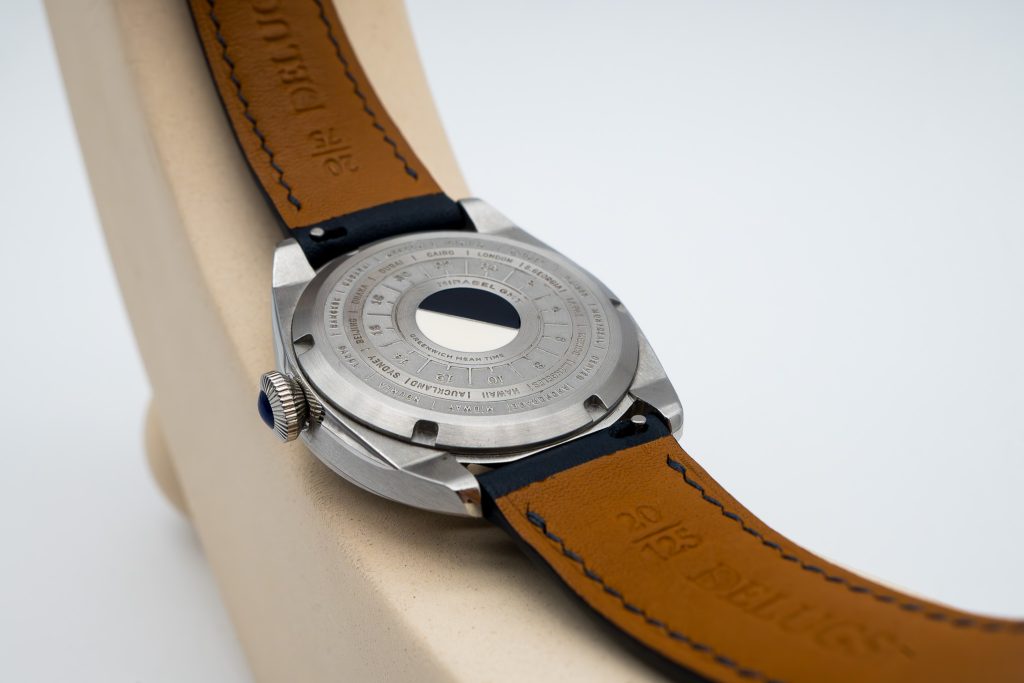
The strap tells you whether a watch brand understands the moment after the purchase, when the newness fades and you’re left with seams, edges, and comfort. Héron includes a Delugs-branded Baranil leather strap with quick-release spring bars. The leather is Baranil calfskin sourced from Tanneries Haas in France, hand-stitched with linen thread and finished with sealed edges. The strap length is listed as 125/75 mm.
In hand, it felt like the right kind of leather for this watch: smooth, substantial, not over-padded, with finishing that reads as intentional rather than merely tidy. The sealed edges mattered more than I expected. Over a couple of days, the strap began to relax, the early stiffness giving way to a more natural curve around the wrist. It didn’t collapse into softness, it simply stopped insisting on its factory shape.
The quick-release system brought a small, human moment of friction. The first time I tried it, it took a minute to find the motion that felt secure rather than fussy. After that, it became the kind of feature you forget until you need it.
The crown is another tactile detail that shapes daily use. The Mirabel GMT has a cabochon pilot crown described as diamond-shaped with a resin insert on the standard models. It’s a decorative flourish, but a practical one: easy to grip, distinct under the fingers, and consistent with the watch’s aviation-leaning inspiration without turning into costume.
The Secret World on the Caseback
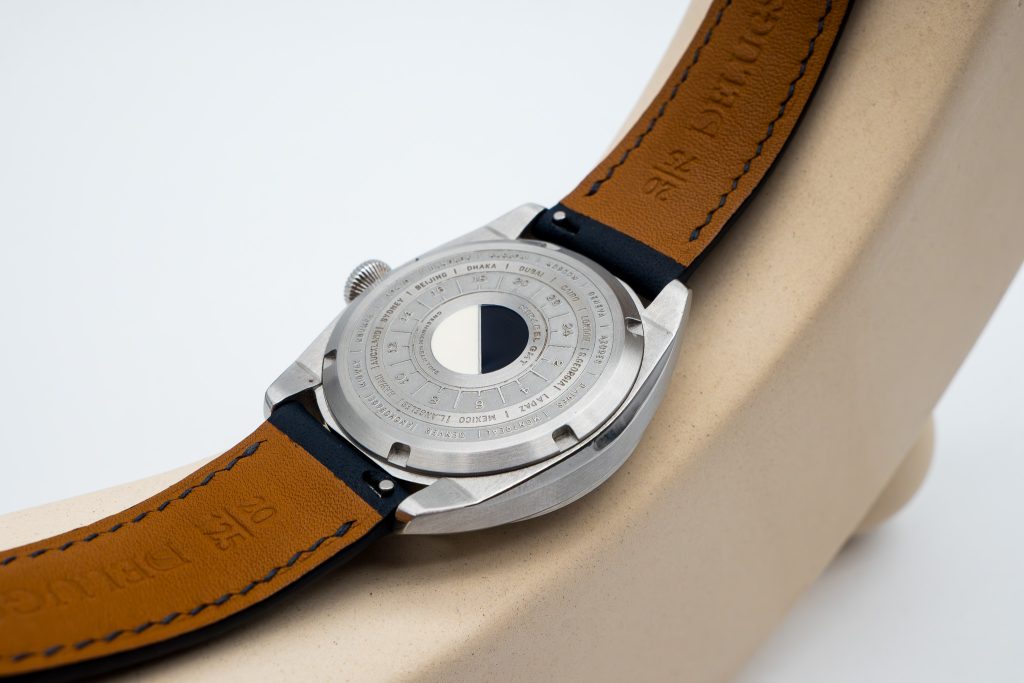
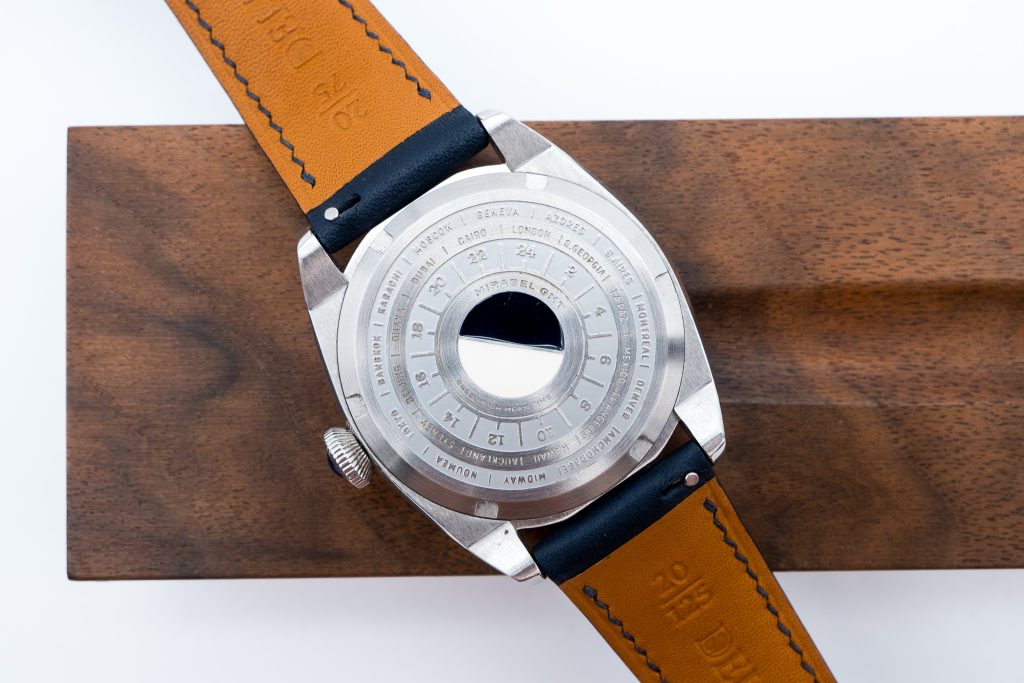
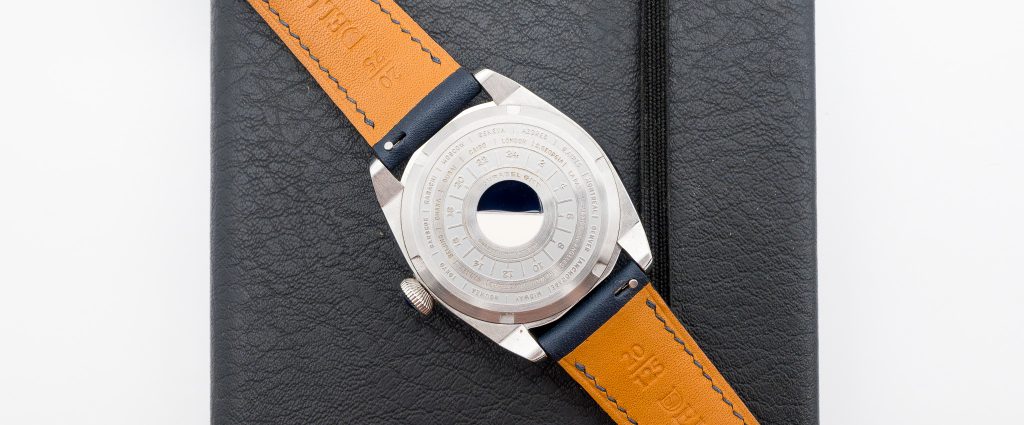
Most casebacks are either transparent for spectacle or closed for silence. The Mirabel GMT chooses a third path: a solid steel “World-Timer” caseback decorated with a GMT world timer design, where each hour corresponds to a city representing its time zone. You don’t need it, strictly speaking, but it gives the watch a private dimension, a reminder of what the complication is for.
I spent time with it in the quiet way you do when something is new. Turning the watch over, reading the city names, tracing the ring with a fingertip. At the center sits a hand-painted enamel centerpiece that separates daytime and nighttime on the world timer, and it hides an internal perlage finish. “Hides” is the right word. The perlage isn’t there to perform for strangers. It’s there as a small act of respect for the object, the kind of finishing that suggests the brand believes you might care, even if you’ll only see it when you take the watch off at night.
There’s a small note of transition embedded in the design: the official product pages state the enamel centerpiece on the caseback will be updated to a navy blue and white design to match the cabochon crown on final production units. That kind of detail can sound minor, but it signals attention to coherence, the sense that the back of the watch deserves the same considered palette as the front.
The $690 Question
At around $690, the Mirabel GMT enters a crowded, contentious space: the sub-$1,000 GMT landscape where brands compete on movement choice, finishing cues, and the promise of versatility. Héron’s argument isn’t volume or ruggedness. It’s refinement with real function.
The substance is easiest to name in materials and execution. You get a 316L stainless steel case, a boxed sapphire crystal with AR coating, an enamel painted sector dial with polished applied numerals, and heat-blued faceted hands on the white variant. You get an automatic “True GMT” Miyota 9075, a movement chosen for the way it lets a GMT behave like an actual travel tool rather than a decorative hand.
The strap inclusion matters here too. A Delugs Baranil leather strap, with sourcing and finishing specified, shifts the value conversation. It feels like an insistence on quality where many watches economize.
My one sustained hesitation, beyond the simple learning curve of setting a GMT the first time, is the watch’s practical boundary: all Mirabel GMT variants list water resistance of 50 meters. In daily life, that means you stop thinking in fantasies and start thinking in habits. I wore it without worry through ordinary handwashing, but it’s not a watch that invites you to forget it’s on your wrist near water.
Who is it for? Someone who wants a dress watch that can travel, and wants that travel expressed with restraint rather than bravado. Who should look elsewhere? Anyone who needs higher water resistance as part of their routine, or anyone who wants a dress watch to disappear entirely under a cuff without the added presence of a boxed crystal.
Final Thoughts
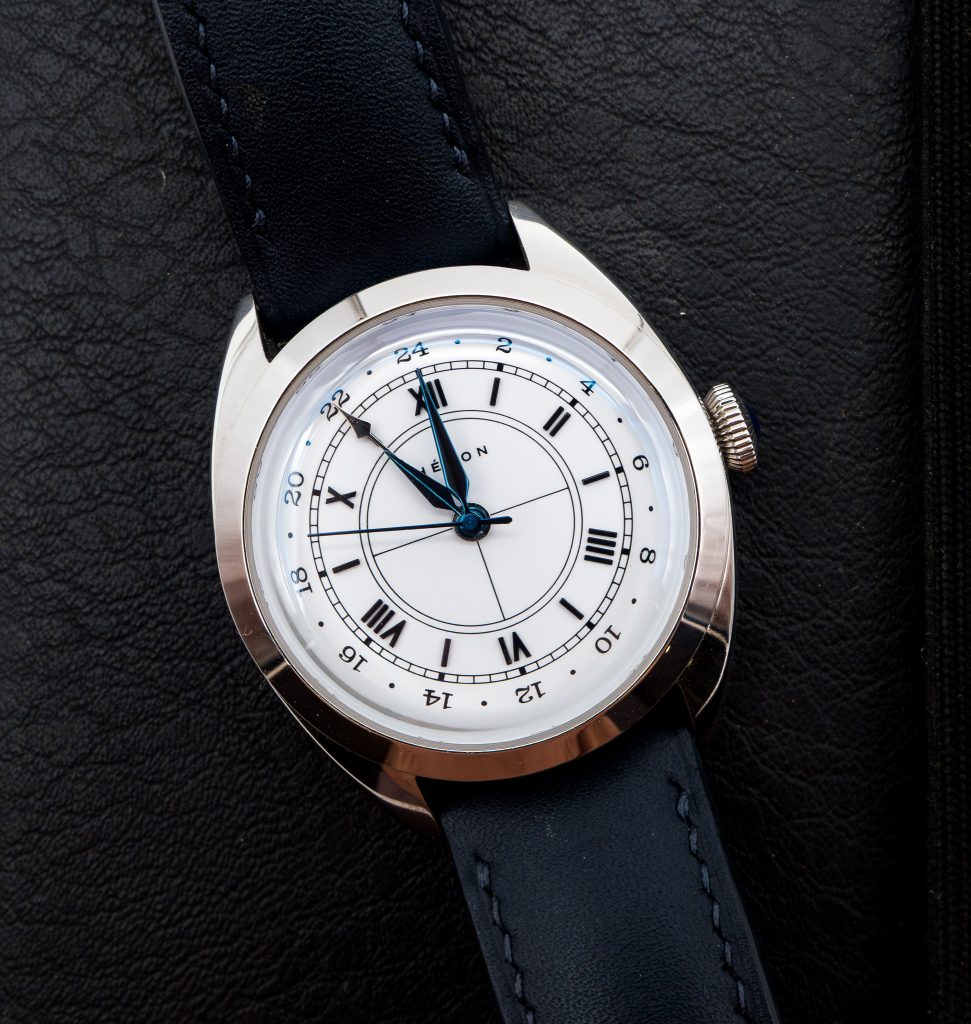
The Héron Mirabel GMT in white succeeds because it doesn’t rely on one loud gesture. It builds its case through a series of quiet, correct decisions: an enamel painted sector dial that holds light with composure, applied numerals that add dimension without clutter, heat-blued faceted hands that remain legible because they’re shaped, not merely colored. The 316L C-shaped case and boxed sapphire crystal give it a neo-vintage silhouette that feels intentional rather than borrowed.
As a GMT, it behaves like a tool dressed for better rooms. The automatic “True GMT” Miyota 9075 makes the second time zone feel practical, not performative, and the power reserve reality matches the cadence of normal ownership: wear it, set it, take it off, pick it up again, and it largely keeps up with your life.
At around $690, the Mirabel GMT offers more than surface charm. It offers a particular kind of substance: finishing choices that reward attention, and a design that doesn’t panic when you look closely. I kept turning my wrist in different light, not to show it off, but to see whether it would keep saying something true. It did.