








The Striso Board Review

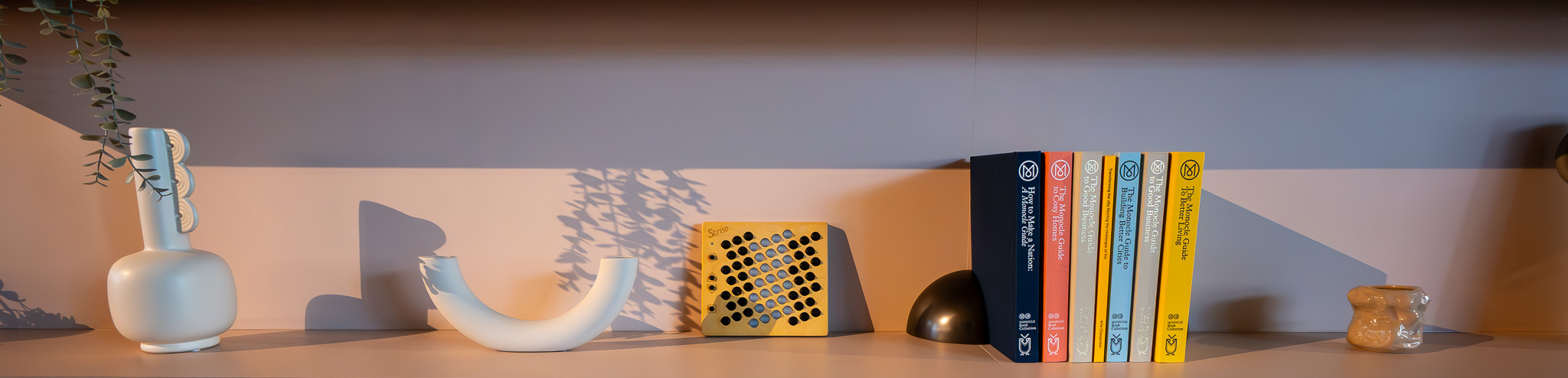
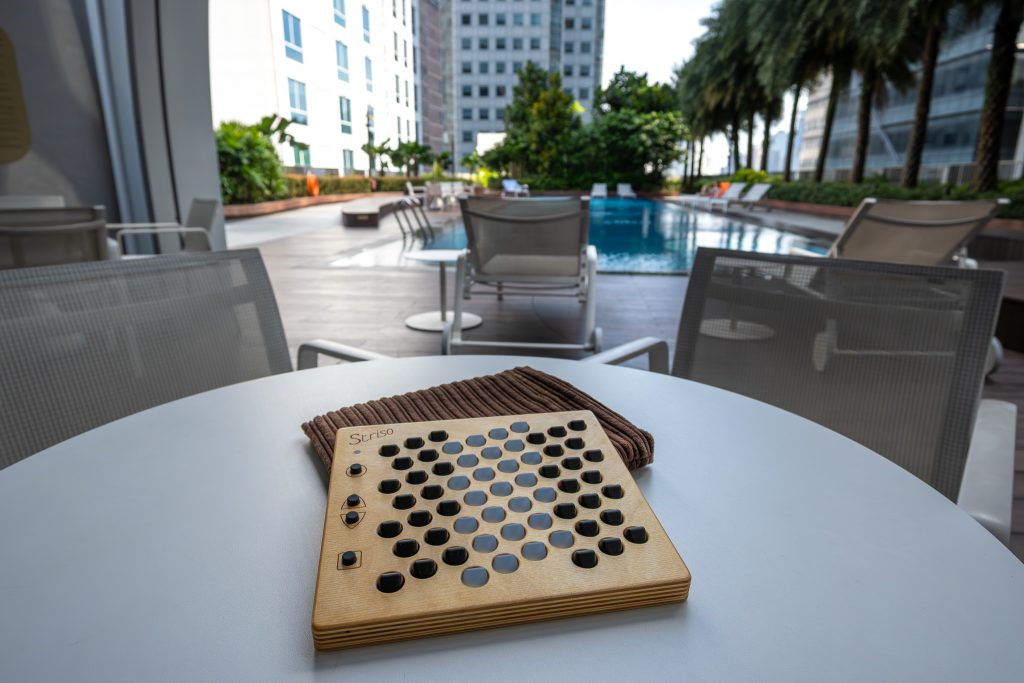
Before I ever plugged it in, the Striso board posed a quiet challenge: what if the thing under your hands did not look like a keyboard at all, but still expected you to think harmonically? It sits on the desk like a small, deliberate object, somewhere between a field recorder and a science project, compact enough to pick up with one hand, yet dense with intent. You do not see rows of white and black. You see a textured grid that asks you to learn it by touch and curiosity rather than by memory of standard keys.
Over a couple of sessions spread across evenings and a morning, I came to see the Striso less as a clever controller and more as an argument about musical design. It combines multidimensionally sensitive silicone keys with an isomorphic note layout related to Wicki-Hayden, aiming to make musical structures legible in the hands, in any key, without the usual penalty of relearning shapes. At its best, it delivers a direct, physical connection to harmony and intonation that many MIDI controllers only gesture toward.
Desk Geography and Daily Access
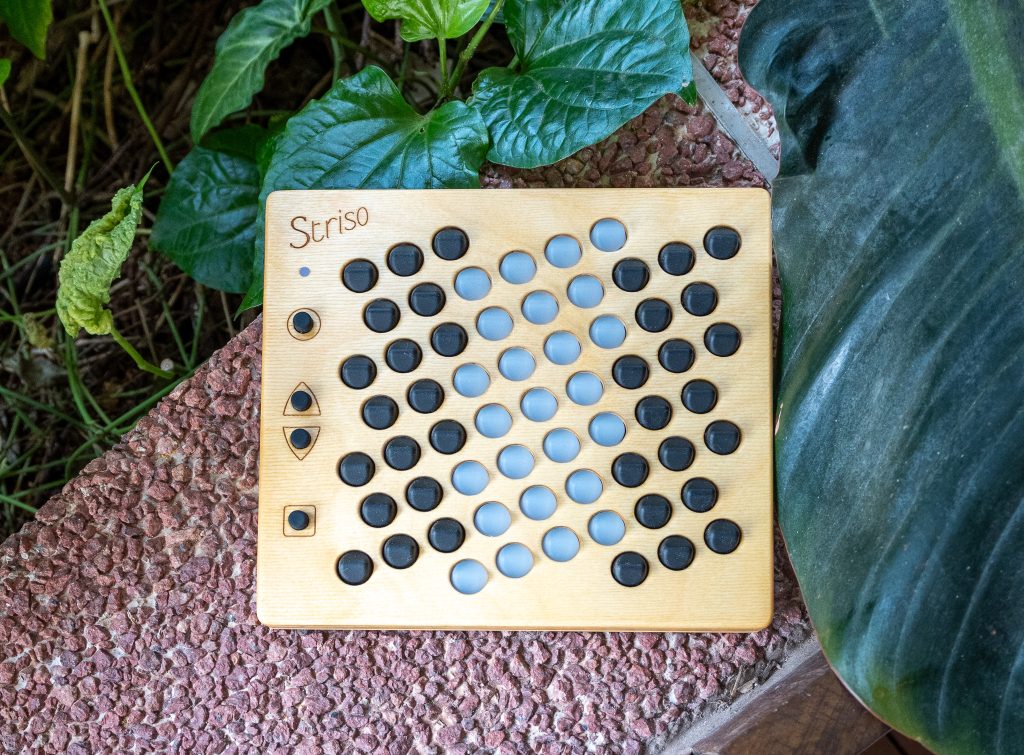
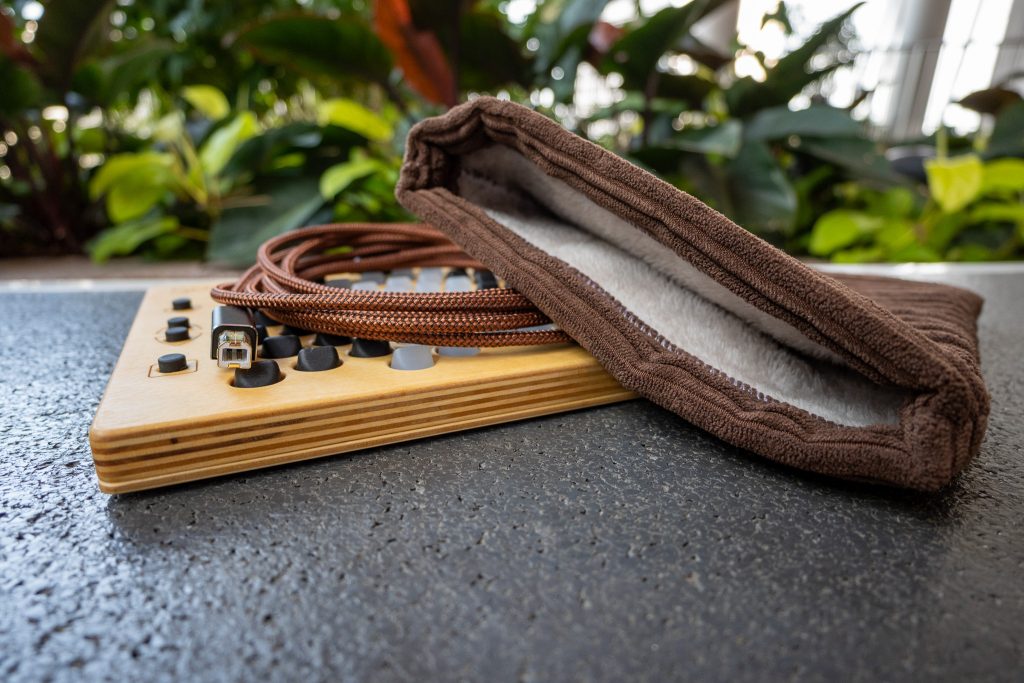
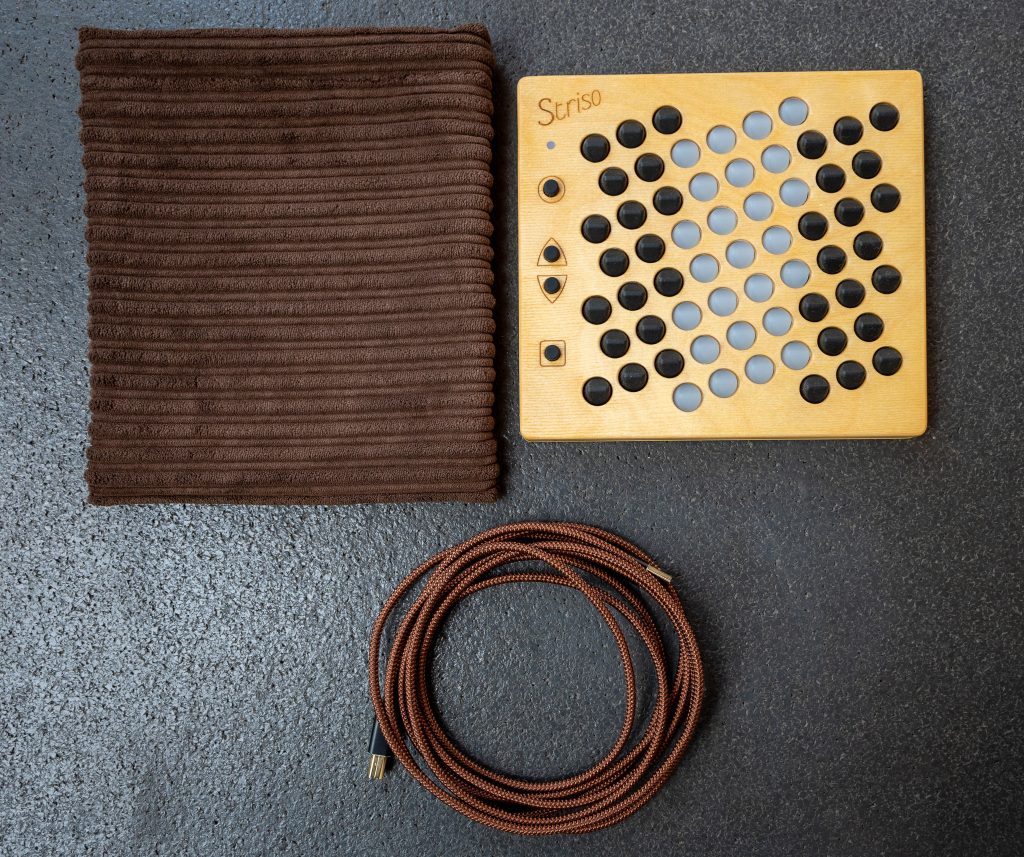
The Striso’s first virtue is logistical. At 192 × 174 × 26 mm and 425 g, it slips into a working routine the way a notebook does. I left it out between a laptop and an audio interface and never felt I was setting up a rig. The included 3 m USB cable helped here. It gave me enough slack to place the board where my hands wanted it, not where the nearest port dictated.
That compactness changes how you approach practice. I moved it from desk to a quieter corner without thinking, then back again when I wanted to record. It also invites a more conversational relationship with the instrument. You can pick it up, rotate it slightly, and treat it as something you handle, not something that anchors you to a bench.
A 3.5 mm stereo audio output sits in the practical category. Headphones or line out. It’s a small detail that makes the Striso feel less like a peripheral and more like a self-contained instrument in the room, even when the rest of your setup is modest.
Sixty-One Keys, One Clear Intent
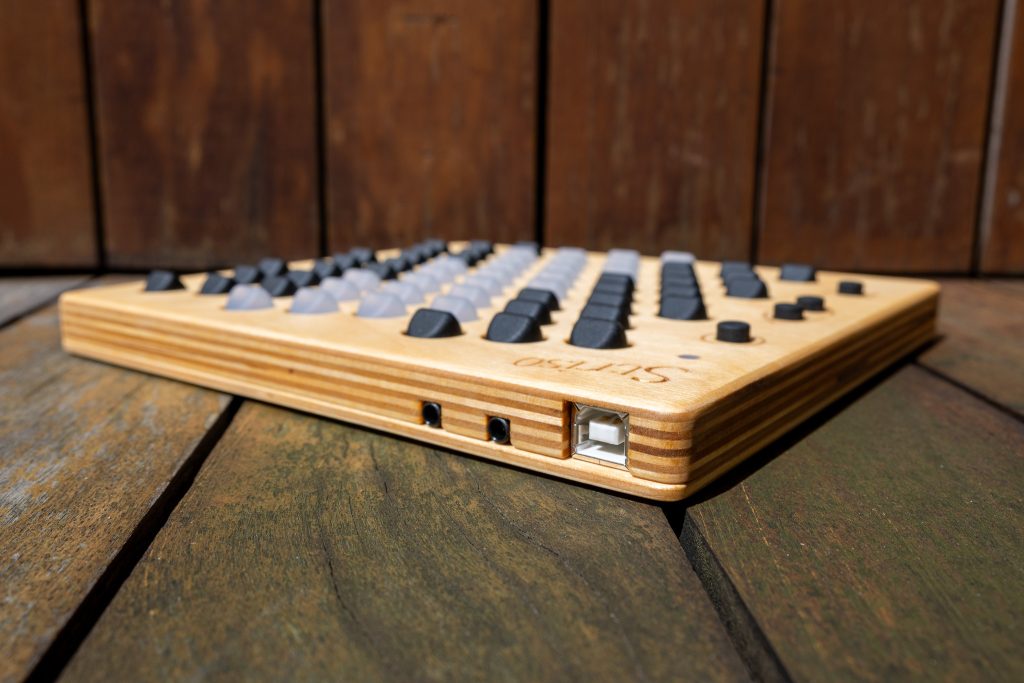
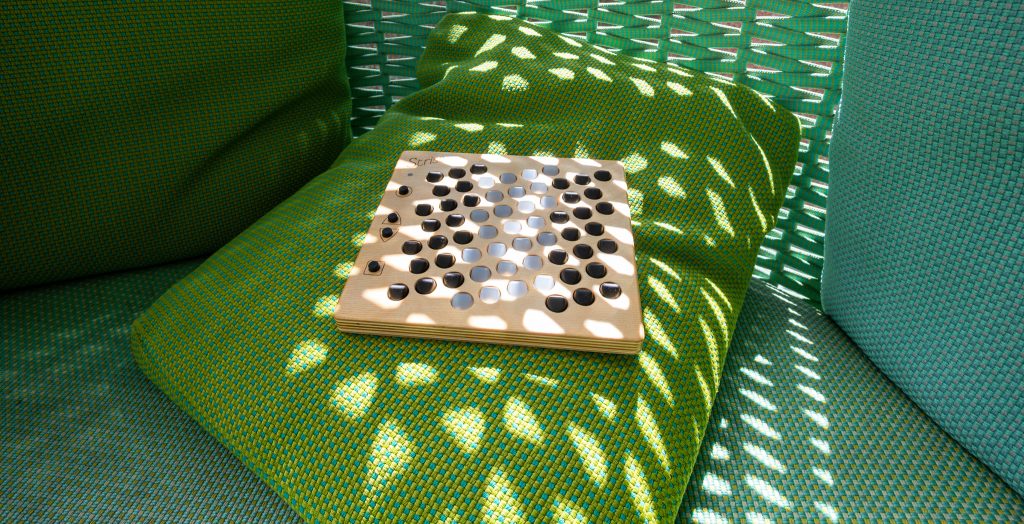
The Striso board’s room count is unambiguous. You get 61 soft silicone keys spanning 3.6 octaves, plus four extra buttons for glissando, octave switching, and settings. The more striking fact is the spatial compression. Those 61 keys cover roughly the same space as a single octave on a piano. That’s not a party trick. It’s the core ergonomic proposition, and it dictates everything about how you will play.
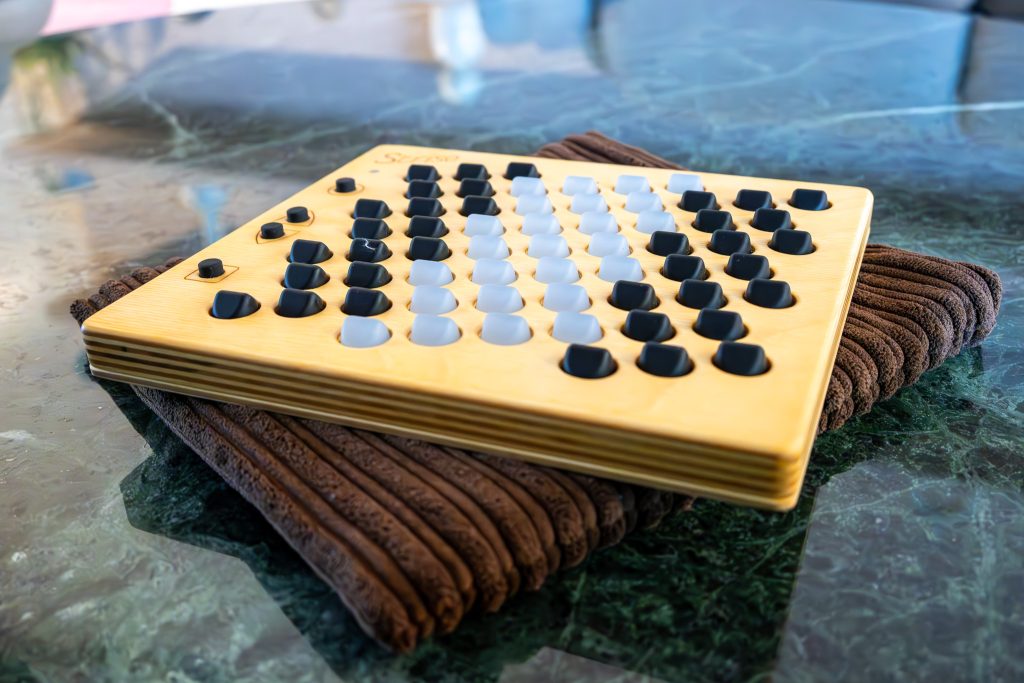
In hand, the keys feel like they were designed by someone who cares about orientation under pressure. Each key has a horizontal ridge that gives your fingertips a reference point, and the silicone flex provides haptic feedback instead of the hard stop you get from conventional buttons. On the first evening, I caught myself over-pressing, trying to bottom out the way I might on a small synth controller. The next session, I eased up and let the surface do what it’s meant to do, which is register nuance rather than force.
The compact chassis and the soft key field also shift posture. I found myself playing closer to the instrument, wrists lower, fingers more deliberate. It encourages precision, not theatrics.
Harmony As A Physical Map
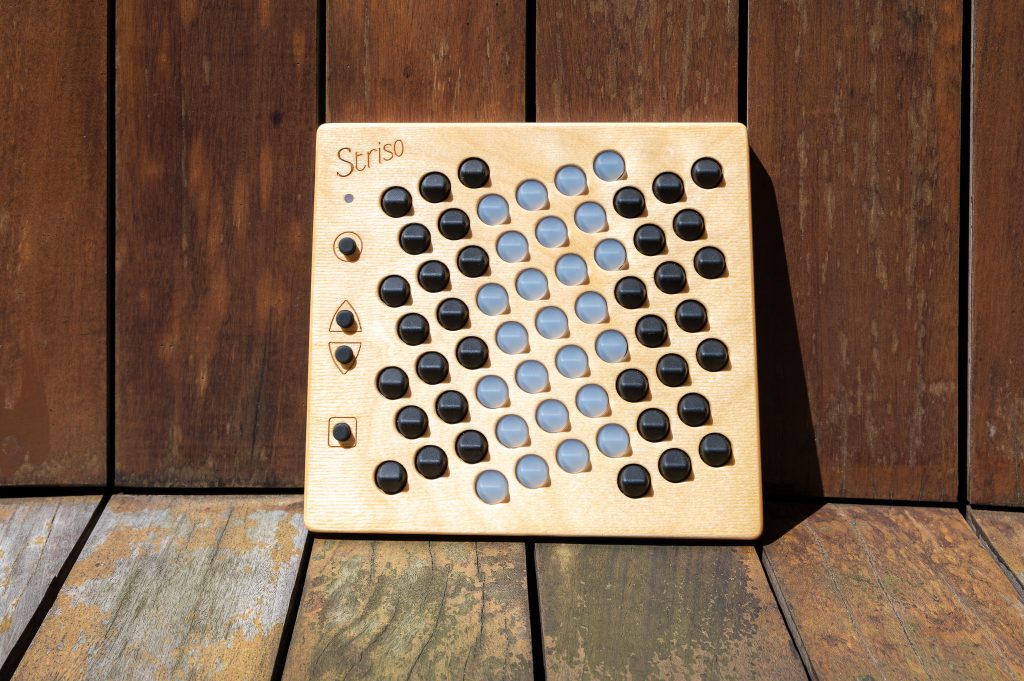
Striso’s note layout is isomorphic and closely related to Wicki-Hayden, which is a technical way of saying something simple. Intervals, chords, and scales keep the same shape in every key. Once you learn a grip, you can move it. You don’t renegotiate the geometry every time you transpose.
The board’s axes are clearly defined. Pitch changes along one axis and the progression of fifths along the other. Higher notes go up, lower notes down. Major intervals are to the right, minor intervals to the left. In practice, this becomes a physical map of harmony. I spent part of a morning moving a chord shape across the surface, then nudging it into a different key without changing the fingering. The sensation is closer to sliding a familiar voicing around the neck of a guitar than it is to playing in a new key on piano.
A second design choice matters just as much. Notes that are close to each other are always in the same key, intended to make harmonic playing and improvisation easier in both diatonic and pentatonic scales. The board gently penalizes random wandering and rewards musical adjacency. It’s an unusually civilized constraint for an electronic instrument.
Technique As The Real Interface
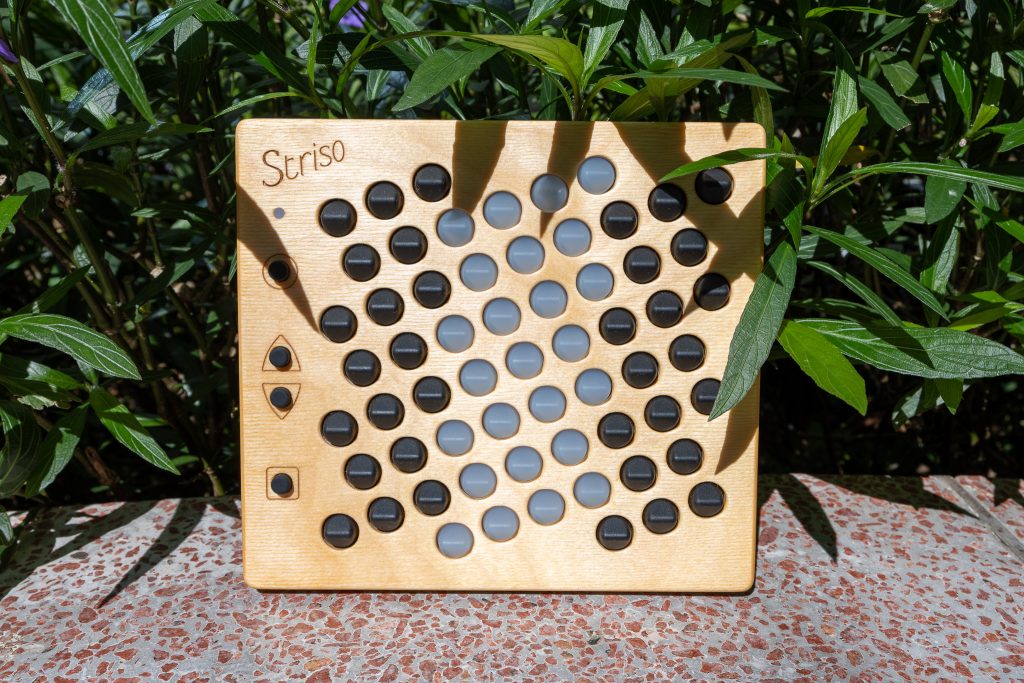
The Striso is described as a very expressive instrument, and the claim stands or falls on its touch system. Each key is pressure and direction sensitive. Loudness, pitch, and timbre can be shaped through finger pressure and left-right and back-forth movements. Striso also specifies a 1200 Hz key-scanning rate, and in use the response feels immediate enough that you stop thinking about detection and start thinking about control.
The sensitivity range is specified at 30 g to 700 g. That lower threshold isn’t academic. A light touch registers, and it encourages a more economical technique. My first pass involved hunting for the threshold, pressing too hard, then backing off until dynamics felt like they were emerging from the fingers rather than from exaggerated motion. Once I settled in, lateral movement became the interesting part. Left-right gestures invite pitch inflection. Back-forth movement suggests timbral shaping. You can approach it as violin-like nuance, or as deliberate sound design.
There’s a learning curve, but it’s the honest kind. You’re developing touch, not memorizing menus. After a later session, I caught myself returning to simple intervals just to enjoy how much life the surface can carry.
Who This Thing Actually Serves
Striso positions the board as fun for both beginners and professionals, and also as an instrument intended to help players understand musical structures. Those are ambitious promises, and they depend on what sort of beginner we mean.
For a true beginner, the advantage isn’t instant virtuosity. It’s that the instrument’s logic is consistent. A chord shape doesn’t become a new problem because you changed key. The isomorphic layout gives beginners a stable set of patterns to inhabit, and the fact that nearby notes tend to be harmonically compatible helps a novice avoid the harshest wrong turns. If you’ve watched new players freeze in front of a piano because the terrain feels arbitrary, you’ll understand the appeal.
For experienced musicians, the value is different. The Striso rewards theory you already know by giving it a coherent physical form. You can treat it as a serious controller in an MPE context, or as a compact instrument for sketching harmony without the baggage of the traditional keyboard’s historical compromises. I’ve spent time with other expressive controllers and alternative layouts in various countries and contexts. The Striso belongs to that lineage, but it keeps its argument focused. Structure first, then expression.
Motion, MIDI, And Tuning As Intention
This is where the Striso board separates itself from many controllers that stop at expressive touch. Connectivity is straightforward and modern. You get MIDI over USB and multiple MIDI modes. There’s an MPE mode with one note per channel. There’s a normal mode with pitch bend, modulation, and polyphonic aftertouch. There’s a monophonic mode with glissando. There’s also MIDI out via a TRS mini-jack of Type A. The board is powered via USB at 5 V and 150 mA, with the practical benefit that it behaves like a dependable studio citizen. Plug it in, it’s ready.
One limitation surfaced quickly and stayed relevant. Polyphony is specified as 15 notes, tied to an MPE limitation. For most melodic work and sensible chord voicings, it’s fine. If you build dense clusters or hold long sustains while layering new harmonies, you can run into the ceiling. It’s not a flaw so much as a boundary, but it shapes how the instrument wants to be played.
Striso also includes motion sensing with 3D rotation and acceleration sent over MIDI at 100 Hz, and you can add accents and effects by shaking and moving the instrument. Because it’s only 425 g, handheld gestures are plausible. Subtle tilts registered for me once I mapped motion to something audible in an MPE-ready context, but it still asks for coordination. You’re playing the keys and the object.
Then there’s tuning, handled with unusual seriousness. The layout is described as tuning invariant and separates sharp and flat notes so alternative tunings such as meantone can be used without a wolf interval. Switching between 12-tet and alternative tunings is part of the system’s identity, not an afterthought. Supported tunings include 12-tet, 31-tet, 19-tet, 5-tet, 7-tet, 1/4-comma meantone, Pythagorean, 7-limit just intonation, Indian Shruti, Bohlen-Pierce, and user-defined tunings. Deviations from 12-tet are sent over MIDI via polyphonic pitch bends, so the tunings work with any MPE-enabled synth. In practice, it means the Striso can inhabit musical cultures that the standard keyboard often treats as exotic theory rather than playable reality.
One small ergonomic complaint belongs here. The sustain or expression pedal input is shared with the MIDI TRS mini-jack. Depending on how you route your setup, that shared port can force a choice you’d rather not make.
Cost, Commitment, And Context
At €544 in the EU including tax, or €449 excluding tax for the rest of the world, roughly $484, the Striso board is priced like a serious instrument, not like an impulse controller. That immediately invites comparison with other expressive and isomorphic instruments I’ve encountered across the years, including Roli Seaboard, Linnstrument, and Lumatone. The Striso’s competitive stance isn’t that it does everything. It’s that it compresses a lot of musical possibility into a compact surface, then extends it into microtonality and MPE expression without turning the player into a systems administrator.
Value depends on whether you’ll use what makes it distinct. If you want a familiar keyboard surrogate, this is the wrong purchase. If you want an instrument that treats harmony as geometry and tuning as a first-class decision, the price begins to look more disciplined. The open-source firmware, with a repository link provided, also signals a long-term posture that many niche instruments lack. Even if you never modify a line of code, you can see the contours of the system, and that matters for longevity.
Purchasing logistics are also refreshingly direct. The shop lists it as in stock, with weekly shipping, and notes that it can be backordered. Outside the EU, import duties and sales tax may be due on delivery. There’s a 30-day money-back guarantee, with a return refunding the product cost excluding shipping. For an instrument this personal, that trial window is an appropriate piece of the value proposition. An optional padded sleeve is available separately, and given the board’s portability, it makes practical sense.
Final Take
The Striso board is best understood as a compact instrument that happens to speak MIDI, rather than a controller trying to impersonate a piano. Its identity rests on two decisions carried through with consistency. It uses an isomorphic note layout related to Wicki-Hayden, and it offers a multidimensional touch surface that rewards careful technique. Together, they make musical structures feel less like abstract instruction and more like something you can hold in the hands, move across keys without penalty, and inflect with pressure and direction.
It will suit players who are willing to learn a new map, especially those drawn to MPE expression, alternative tunings, and the kind of compositional work where harmony is something you explore, not something you execute by habit. It will frustrate anyone who wants immediate familiarity or who expects unlimited polyphony in an MPE context. The 15-note limit is real, and the shared pedal and MIDI TRS jack can complicate a setup.
After a later session, I found myself playing more slowly than usual, not because the Striso demanded caution, but because the surface made small decisions feel consequential. Fingers settle into the ridges, pressure becomes phrasing, and the instrument quietly insists that theory isn’t a textbook. It’s a physical place you can visit.