









SpaceOne WorldTimer Watch Review

There’s a particular kind of pause when you strap on something that doesn’t quite read as “watch” anymore. Not a smartwatch, not a vintage-inspired three-hander, but a small piece of equipment that feels like it escaped from a control panel and ended up on your wrist. The WorldTimer Black lives in that space between instrument and jewelry, and over a couple of days it forced me to decide whether I enjoy that tension, or just like the idea of it.
By Friday morning it was on my wrist for meetings and desk work; by Saturday it had been through errands, a long walk, and an evening out. The central question with the WorldTimer isn’t whether it’s “futuristic.” It is. The question is whether the concept survives contact with real life: can you read it quickly, live with the size, and justify €2,700 before taxes for a mechanical watch that’s proudly unconventional.
Friday Wrist, Saturday Wrist

This watch doesn’t “go with everything.” It declares itself. On a Friday office day, it felt like wearing a piece of equipment, the kind of object that invites a glance even when you’re not checking the time. Under indoor fluorescents the black case looked matte and purposeful. In daylight it picked up more reflection than I expected—not shiny, but alive enough to show the curves.
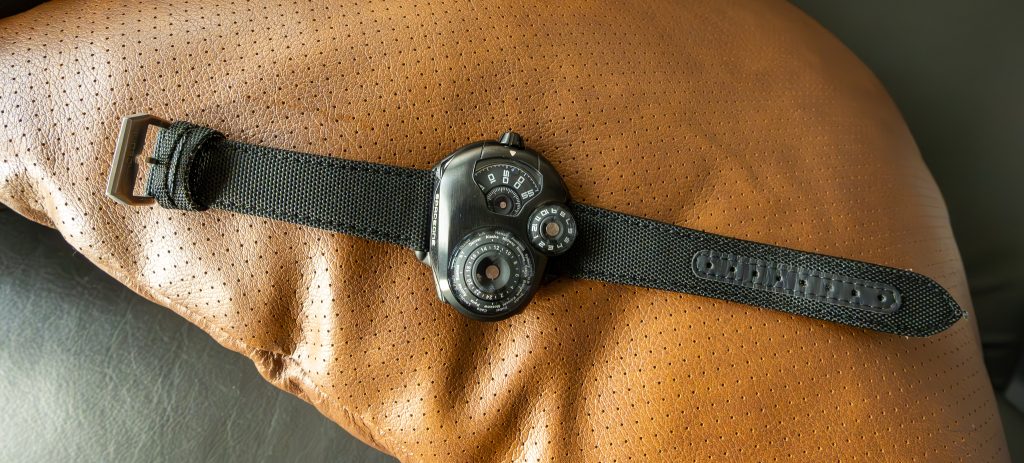
That same presence is also the practicality test. The WorldTimer Black is big on paper and big in the mirror: 52.7 mm long, 41.9 mm wide, and 15.88 mm thick, with sapphire domes adding height and visual drama. Still, it didn’t wear like a brick. Titanium helps. Grade 5 titanium has a reputation for strength and corrosion resistance with lower weight than stainless steel, and that tracks with how this felt over a workday. I never had the wrist-fatigue that usually arrives when a large steel case spends hours on a keyboard.
What I did notice, immediately, was the thickness around shirt cuffs. A couple times, sliding my wrist out from under a cuff took an extra beat. Not a dealbreaker, but a real reminder that the design is doing something different, and that “different” has physical consequences.
Learning to Read the Discs
SpaceOne‘s whole pitch lives or dies on the display, and it’s legitimately original. Traditional hands are replaced by rotating discs: a minutes disc at 3 o’clock, a central seconds disc, a 12-hour disc at 6 o’clock, and at 9 o’clock, two coaxial discs showing 24-hour time and the corresponding cities.
The first five minutes were messy. I had to stop thinking like a person who’s read hands since childhood. The minutes disc at 3 o’clock was the main mental adjustment. My eye wanted minutes to be “everywhere,” sweeping around a dial, not concentrated on the right side. For the first hour, I checked time more often than I needed to, partly because I didn’t trust my own read.

Then it clicked. Somewhere around the 10 to 15 minute mark of actual use, the layout became internalized: minutes right, hours down, seconds in the middle, world time left. After that, the read was fast enough for normal life. Not as instant as a clean three-hander, but quick enough that I wasn’t performing math every time I wanted to know if I was late.
Visually, the rotating seconds disc is the hook. It’s continuous, smooth, and quietly hypnotic. In practice, it did what a good seconds hand does: it made the watch feel alive, without the audible tick that often comes with that reassurance.
Black Titanium, Real-World Wear

The Black edition uses a black-treated Grade 5 titanium case with mixed finishes, and it’s the right material choice for the concept. This case isn’t trying to be delicate. The combination of polished, brushed, and sandblasted surfaces gives the shape definition, so it doesn’t collapse into a single matte blob. Running a fingertip across it, you can feel the transitions, and you can see them when light hits the edges of the case geometry.
The sapphire domes are a huge part of the build impression. They catch light and create depth over the discs, like you’re looking through a visor. It’s also what makes the watch feel taller than some 15.88 mm watches in a more conventional architecture. The dome is height you see.

The strap proportions suit the size: 22 mm at the lugs tapering to 18 mm. Over two days, the fabric strap was consistently comfortable, even during a Saturday that involved a lot of walking. It didn’t feel bulky, and the taper kept the watch from looking like a slab strapped to the wrist.
My one real cosmetic annoyance was fingerprints. The black finish picked them up more than I expected. I ended up wiping it once or twice with the cloth, which felt faintly ridiculous for something styled like space hardware, but also honest. If you want a black watch that always looks untouched, this isn’t that.
Swiss Backbone, Paris Brain

Under the design theater, the architecture is straightforward in a good way. The WorldTimer models use a Swiss automatic Soprod P024 movement, paired with an in-house WorldTimer complication module. That module was developed and assembled in Paris by Théo Auffret and his team, and the watch itself is developed and assembled in France
That hybrid identity matters. This doesn’t present as a heritage Swiss world-timer, and it doesn’t pretend to be one. The Soprod base gives the project a recognizable mechanical foundation, while the Paris-developed module is where the watch earns its personality. It’s also consistent with the larger SpaceOne vibe: “Manufactured on Earth,” but with a specific European design and assembly context.

In use, the movement felt like what it is: an automatic with a complication layered on top, operating through a crown that has to do more than a simple three-hander. Winding it to get it started, I gave it roughly 30 to 40 manual winds. Setting time and then aligning the world-time display took a minute of crown-position discovery. Once I had it, the crown action had enough resistance to feel precise, not toy-like.
In a quiet room, the rotor was audible. Not loud, but present when you move your wrist and everything else is still. That small bit of sound matched the watch’s instrument-panel personality. It reminded me that the “digital” look here is still mechanical, still physical.
When World Time Actually Matters

A world-time display is only worth paying for if you use it, and I did, quickly, in the most normal way: a Friday evening video call. I rotated my attention to the 9 o’clock discs, where the 24-hour scale and cities sit coaxially, and checked the time for another city. I used Tokyo once, and New York another time, mostly because those are the time zones that come up in my life.
The mechanism is the point. On a typical GMT watch, you’re often dealing with an extra hand and mental conversions, or you’re using a bezel as an interpretation tool. Here, the display is already an interpretation: city matched to 24-hour time, right there, always in the “cockpit.” Once you’ve learned the layout, it becomes a glance, not a project.
There’s also a social reality to a watch like this. In a Friday meeting, a colleague asked what I was wearing, because it doesn’t scan as a normal analog watch from across a table. Explaining it forced me to articulate what SpaceOne is attempting: a mechanical watch that behaves visually like a reimagined digital display, driven by discs instead of hands.
That explanation is either fun or exhausting, depending on your tolerance for attention. I enjoyed it once. I wouldn’t want to do it every day.
Specs Without the Theater

SpaceOne positions the WorldTimer as a disc-based, “digital” reimagining, but the utility comes from conventional watch needs executed in unconventional ways. You get hours, minutes, seconds, a 24-hour indicator, and world-time/time-zone display via rotating discs. The system is visually dense, yet organized enough that it becomes usable after a short learning curve.
On the mechanical side, the Soprod P024 runs at 28,800 vibrations per hour (4 Hz), with a stated power reserve of 38 hours. That reserve played out in a way that felt honest: after taking it off overnight and leaving it unworn for about 14 hours, it was still running the next morning. If you leave it off wrist for a weekend, you should expect to wind it and reset rather than hoping it soldiers through.
Water resistance is rated at 3 ATM (30 meters), which sets expectations. I treated it like a watch that can handle daily life and incidental splash exposure, not a watch you wear into water on purpose.
SpaceOne backs the WorldTimer with a two-year warranty, and the watches are offered with international delivery through the brand’s website. It’s a modern microbrand ownership model, and it matches the product’s contemporary, design-led approach.
The Price of Being Different
The WorldTimer Black is listed at a starting price of €2,700 before taxes, the same entry point as the Blue and Titanium variants. In the world-time category, that price lands in an interesting place. A world-time complication has a way of climbing quickly into high horology territory, and this one arrives in a Grade 5 titanium case with a display that isn’t derivative of the usual templates.
Limited production is part of the value story, too. The WorldTimer collection includes three variants, and the Black edition is described as limited to 100 pieces for its initial offering. Coverage around the first batch also points to a total run limited to 600 pieces split across finishes, with deliveries targeted before the end of 2025. Scarcity doesn’t equal value automatically, but it does shift what you’re buying. This isn’t meant to be common.
What you’re paying for, concretely, is a mechanical watch with a Swiss automatic base, a Paris-developed complication module, French assembly, and a case material and finishing approach that aligns with its aesthetic intent. What you’re paying for, less concretely, is the willingness to live with a watch that doesn’t try to be discreet.
For me, the price makes sense only if the disc display is the point, not a novelty.
Space Instrument or Wrist Costume

SpaceOne draws openly from space exploration and the 1960s space-age design era, and the WorldTimer is committed to that premise. The dial architecture, the domed sapphire, the instrument layout, the black-treated titanium shell—all of it reads as “space cockpit,” which is exactly how many people describe it when they see it.
The cohesion is real. It doesn’t feel like a normal watch with a sci-fi skin. The disc display forces the case and crystal design to do different work, and the watch follows through. The domes aren’t decorative. They’re part of how the whole thing becomes legible, layered, and dimensional.
Still, there were moments where it felt close to costume. On Saturday night, in a more social setting, the watch pulled attention in a way a conventional world-time watch rarely does. Sometimes that’s the joy of it. Sometimes it’s the feeling that you’re wearing a prop. Your tolerance for that line will decide whether the design reads as coherent or as a gimmick.
I landed in the middle: I admire the discipline, and I wouldn’t make it my only watch.
Final Thoughts
The SpaceOne WorldTimer Black is a mechanical world-time watch that refuses the usual vocabulary. It replaces hands with rotating discs, builds a “digital” readout from purely mechanical motion, and wraps the whole thing in a black-treated Grade 5 titanium case that feels more like a housing than a frame. It’s developed and assembled in France, anchored by a Swiss Soprod P024 and a Paris-developed WorldTimer module, and that blended identity suits a brand chasing space-age optimism rather than tradition.
This watch is for someone who wants to participate in the design, not just wear it. If you like learning a display, if you enjoy being asked what’s on your wrist, and if the idea of a French-assembled, space-inspired instrument-watch appeals more than a classic dial, the WorldTimer earns its keep.
Skip it if you want instant readability, slim proportions, or a world-time watch that disappears under a cuff and never needs an explanation. The WorldTimer doesn’t disappear. Even when you stop looking at it, the central seconds disc keeps turning, quietly insisting that the whole point here is motion made visible.