







MUU Bangkok Hotel Review

On a humid Thursday afternoon, Sukhumvit 55 felt like a slow-moving stream of metal and reflections, and Thonglor hummed with its usual mix of caffeine, perfume, and engine heat. I wasn’t here for temples or skyline trophies so much as to see whether a self-described “boutique luxury” hotel, folded into a mixed-use complex, could genuinely belong to this neighbourhood rather than perch above it. MUU Bangkok, tucked into the Eight Thonglor “vertical village,” was my test case.
Thonglor is where Bangkok experiments on itself. It’s less about temples and royal vistas, more about MICHELIN-noticed kitchens, Japanese izakayas, and late-night cocktail dens. MUU positions itself right in the middle of that scene, literally and conceptually. The brand talks about luxury as whatever makes you happy and about community as the organizing idea. I was curious whether that translated into an honest conversation with the neighbourhood or just a stylish shell plugged into a mixed-use building.

Arriving mid-afternoon, I wheeled my bag past a small cluster of residents heading toward the lifts, which immediately underscored MUU’s hybrid nature. This isn’t a hermetically sealed resort but a building that combines high-end residences with 148 hotel rooms and larger long-stay suites. By the time I’d drifted between the pool deck, the MUU Social Club, Otto Italian, and 008 Bar, a clear picture emerged: MUU Bangkok is less about spectacle and more about quietly, confidently inhabiting its corner of Thonglor.
Thonglor, Not the Postcard Center
MUU sits on Sukhumvit 55, better known as Thong Lo Road, in the Watthana district. That address matters. Bangkok can be overwhelming if you try to be “central” to everything; MUU instead plants you in a specific conversation: food, nightlife, and design in one of the city’s most dynamic neighbourhoods.
From the lobby, I could step directly into Eight Thonglor’s upscale shopping and lifestyle complex. That vertical convenience shaped my days. One evening I cut through the building to pick up a few things at DONKI Mall Thonglor, which is within comfortable walking distance, then wandered over to J Avenue, another nearby lifestyle cluster. Thonglor’s strong Japanese presence is very evident—you pass ramen counters, discreet sushi bars, and bilingual signs every few metres.
The trade-off is obvious. Grand Palace, Wat Pho, and the riverside hotels feel far away. MUU isn’t for someone who wants to wake to a view of the Chao Phraya or stroll to heritage sites. Instead, it functions as a sophisticated Sukhumvit/Thonglor base. During the day, I used the complimentary shuttle down to Thong Lo BTS station, which sits at the junction with Sukhumvit Road. The ride covers the roughly 800–1200 metres that would otherwise mean a hot walk along a busy avenue. From there, the rest of the city opens: a few stops to The Emporium, EmQuartier, and the newer EmSphere, a short ride to Queen Sirikit National Convention Center or Benjakitti Park.
Traffic on Thonglor can snarl, particularly around meal times, so I found myself relying on the BTS or simply staying in the neighbourhood. Terminal 21 at Asok was an easy drive when I needed it, but most evenings I chose to explore nearby bars and MICHELIN-listed dining, guided by the concierge’s suggestions. MUU’s location rewards travellers who want to plug into contemporary Bangkok life rather than chase a checklist of monuments. For first-time visitors focused on classic sightseeing, I’d steer them closer to the river. For repeat guests or business travellers who prefer a stylish, lived-in urban neighbourhood, this address makes sense.
A Quietly Cinematic Urban Shell
MUU describes itself as boutique and contemporary, with nods to 1920s design and custom Thai furnishings. Walking into the public spaces, the first impression isn’t of a theme park version of Art Deco but of a modern building that borrows selectively from that vocabulary.

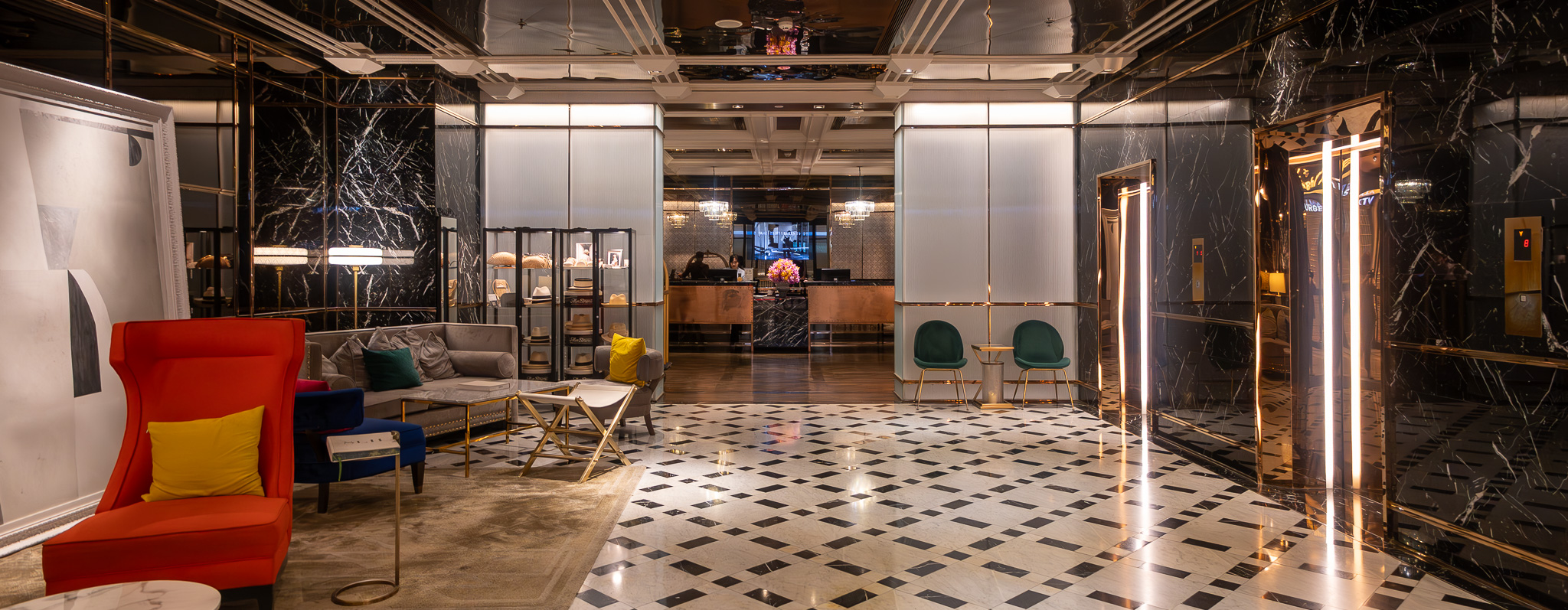
The lobby and main circulation zones feel polished and urban, with dark woods, warm metals, and clean-lined furniture that hint at the 1920s without mimicking a movie set. The Thai influence appears in the proportions and in the detailing of the furnishings: carved woods, textiles with subtle local patterns, pieces that feel commissioned rather than off-the-shelf. My mother, who painted interiors for much of her career, always said you can tell a lot from how a chair meets the floor. Here, chairs and tables have that slightly heavier, grounded quality you often find in Thai design, even when the silhouette is modern.

MUU Social Club, which doubles as breakfast venue and lounge, leans more explicitly into Art Deco. I noticed geometric patterns in the flooring and light fixtures with a glamorous, almost cinematic glow in the evenings. The palette runs to deep tones: burnished gold, dark upholstery, marble and glass. In the softer morning light, with coffee cups clinking and a mix of Thai and international accents at the tables, the room read less “retro set piece” and more cosmopolitan salon.

The 11th floor is where MUU comes together most convincingly. The double infinity-edge swimming pools stretch along the building’s edge, framed by landscaping that softens what could have been a simple rooftop rectangle. At one end, a jacuzzi pool bubbles away; at the other, the water appears to dissolve into the skyline. Standing there in the late afternoon, watching the sun catch on neighbouring towers, I understood why people linger. The poolside bar contributes a relaxed, social charge: the clink of ice, low music, a few conversations in multiple languages.
Just inside, Otto Italian, the signature restaurant, and the 008 Bar are tucked on the same level. 008 is a speakeasy-style cocktail bar with dimmer lighting and a moody atmosphere that contrasts with the sunlit pool. The spatial flow means you can move easily from a swim to an aperitivo to dinner and then a drink, all on that upper plateau, which reinforces MUU’s ambition to be a compact social hub rather than just a place to sleep.
What I appreciated most was that the design rarely shouts. The 1920s inspirations and Art Deco references serve as framing devices, but the materials and textures feel tailored to Bangkok: timber, marble, and Thai-crafted pieces that keep the hotel from becoming an interchangeable “design hotel” that could just as easily sit in Dubai or Miami. MUU reads as contemporary Bangkok filtered through a slightly nostalgic lens, not an imported fantasy.
Entry-Level Room, Grown-Up Comfort
My Deluxe King room, at about 37 square metres, sits at the entry point of MUU’s accommodation ladder, below the larger suites and long-stay residences. Many hotels treat this category as a necessary minimum. MUU treats it as a fully considered space.
Opening the door, I stepped onto timber flooring that immediately gave the room a warmer, residential feel than wall-to-wall carpet. The layout is straightforward but well judged: a short entry, a wardrobe and storage zone, the king-sized bed oriented to face the TV and seating area rather than directly facing the door, and a marble bathroom with separate bathtub and rain shower behind sliding or hinged doors.

The first thing I did was walk straight to the window and pull back the curtains. My room had a city view, with a cross-section of Thonglor’s mid- and high-rise buildings layered one behind the other. Light during the day was generous without being harsh. At night, the view turned into a grid of illuminated windows, which always reminds me a little of my childhood in high-rises in Paris: other lives stacked above and below.
Sleep quality has become the quiet test I apply everywhere. MUU passes. The king bed comes dressed in 400-thread-count bedding that feels soft but substantial, not the slippery, overly shiny sheets some luxury properties favour. The pillow menu meant I could adjust to a slightly firmer option the second evening, and the combination made it very easy to sleep through Bangkok’s urban hum. Sound insulation proved adequate; once inside, I heard almost nothing from the corridor or neighbouring rooms.


The marble bathroom impressed more than I expected at this category. The rain shower had consistent pressure and temperature control, and the separate tub was deep enough to be inviting rather than perfunctory. Counter space around the sink allowed for a proper scattering of toiletries, and storage niches handled everything else. Those small details matter when you’re living out of a suitcase. The marble surfaces felt cool underhand in the morning, a tactile contrast to the timber in the main room.
Functionally, the room works. I used the desk as a workspace with the complimentary Wi-Fi clocking in at speeds that easily handled video calls and large file transfers. Outlets were where they needed to be, including near the bed for charging phones. The TV’s IPTV setup was straightforward, though I admit I used it more as background than entertainment. A private bar/minibar, robes, slippers, in-room safety box, and a coffee/tea maker rounded out the expected amenities, with complimentary bottled water replenished.

Storage is always an issue in entry-level rooms. Here, the wardrobe and drawers were sufficient for hanging clothes and stowing a medium suitcase. I ended up leaving my larger bag open on the luggage rack and still had room to move comfortably, which speaks to how the 37 square metres are planned. The room isn’t showy; it’s quietly efficient and comfortable in a way that suggests someone who actually stays in hotel rooms every week had input.
MUU’s larger suites and residences, which extend up to 234 square metres with multiple bedrooms, full kitchens, and terraces, clearly cater to longer stays and families. The fact that the smallest room still feels generous by inner-city Bangkok standards supports MUU’s claim to be a hybrid of hotel and serviced residence. This is a room category I’d happily book for a working week, not just a quick stopover.
People, Not Scripts, Running the Show
Service at MUU aligns with its membership in Small Luxury Hotels of the World rather than with the more formulaic approach of big chains. From the first greeting at reception, the tone was warm, quick, and unfussy. Check-in mid-afternoon took only a few minutes, with the essentials explained clearly but without an unnecessary performance.
Thai hospitality often expresses itself as a combination of attentiveness and restraint, and MUU leans into that. Staff were consistently friendly and present, yet I never felt hovered over. Housekeeping slipped in while I was at breakfast and had the room reset with an efficiency that, after years on the road, I’ve come to appreciate as much as elaborate turndown rituals.
The concierge team stands out. I tested them by arriving with a short list of Thonglor restaurants and asking for honest guidance rather than the usual “all are excellent.” The conversation quickly widened to include their own favourites, including MICHELIN-recognised Thai restaurants such as Bo.Lan and Khao, as well as The Commons, a community-focused multi-restaurant space nearby. They helped map out walking distances and BTS connections, and volunteered to book tables at peak times. Their recommendations matched the neighbourhood’s creative and culinary reputation rather than defaulting to the safest tourist options.

Each interaction reinforced a sense of service that adapts rather than prescribes. When I asked about late checkout on my final morning, the answer was framed in terms of possibility rather than policy, and within a few minutes it was confirmed, which aligns with the flexible benefits often associated with SLH partner programs. Staff at the MUU Social Club remembered my coffee preference by the second breakfast, and at the pool, service at the bar was attentive without being pushy.
This isn’t the lavish, hyper-formal choreography of a grand palace hotel, nor does it feel like an anonymous corporate operation. MUU’s service philosophy feels appropriately scaled to its boutique size and its Thonglor context: professional, personal, and grounded in local knowledge.
Eating In When the City Tempts Out
In a neighbourhood where you can eat extraordinarily well within a few blocks, a hotel has to justify any decision to dine in. MUU manages to do that in key moments, though the gravitational pull of Thonglor’s independent restaurants remains strong.


Breakfast at MUU Social Club sets the daily tone. The room works differently at 8 a.m. than it does late at night. In the mornings it’s bright, with natural light softening the Art Deco edges. The buffet stretches with a broad selection, but what elevates it is the combination of that spread with cooked-to-order items from a menu delivered to the table. I built a rhythm quickly: a first pass for fruit, pastries, and local items, then an egg dish or something heartier from the à la carte offerings. Coffee arrived promptly and to a reliable standard. This is breakfast that justifies lingering rather than grabbing something on the way out.

Dinner at Otto Italian, the signature restaurant on the 11th floor, leans toward Southern Italian and Mediterranean cuisine, a logical choice in a city where Thai food outside the hotel is world-class. On one evening, I opted to stay in and watch the sky shift from the dining room’s vantage. The room has a warm, contemporary feel, and the cooking is clean and confident, with the bright flavours and olive oil-forward dishes you’d expect from that region. It felt more like an urban Italian restaurant that happens to be attached to a hotel than a generic “all-day dining” outlet.
Later that night, I slipped into 008 Bar, the speakeasy beside the pool. The lighting drops several levels as you enter, the noise of the pool fades, and you find yourself in a compact, moody space where the focus is on cocktails and conversation. This bar feels at home in Thonglor’s bar scene and could easily attract locals as well as guests. It plays into MUU’s community narrative more than any marketing line ever could.


MUU also runs a poolside bar and a café, and room service is available for those evenings when Bangkok’s humidity convinces you to stay in. At one point in the late afternoon, I ordered something light by the pool and watched families and couples drift in and out of the water. MUU hosts a complimentary manager’s reception daily, with drinks or snacks at set times, which further blurs the line between resident and visitor, regular and newcomer.
Does MUU’s F&B reflect Bangkok and Thonglor directly? Breakfast does in the inclusion of local dishes and the way the Social Club doubles as a social hub. Otto and 008 reflect the neighbourhood through their sophistication and style rather than overt “Thai-ness.” The hotel seems to accept that its guests will eat Thai food abundantly outside its walls and instead focuses on creating polished, reliable options when staying in.
Urban Resort Energy on the Roof
For an urban property in a mixed-use building, MUU assembles a convincing set of leisure and business facilities. The elevated pool deck remains the star. I visited twice, once in the mid-afternoon heat and again closer to sunset. The double infinity-edge configuration, with a children’s pool section and the jacuzzi at one end, allows guests to find their own corner. Landscaping softens the edges, and the view over the city reinforces the sense of being above the fray while still in the middle of it.


The modern fitness center sits nearby, equipped with the usual range of cardio and strength machines. I used it early one morning when the city below was still shaking itself awake. Machines were in good working order, and the room felt bright and functional, not like a token gym. A spa suite operates on site, and saunas sit in the lounge area near the gym, a welcome touch in an urban hotel where unwinding after a day in Bangkok’s heat and traffic can make the difference between a good stay and a great one.
For more pragmatic needs, MUU has a business center and coffee and tea available in common areas, plus a snack bar or delicatessen concept that allows you to grab something on the go. Complimentary high-speed Wi-Fi extends across the property, including public spaces, and I found it easy to move from room to lobby to pool with my laptop when deadlines intruded.


The complimentary area shuttle to Thong Lo BTS is perhaps the most valuable amenity of all for those planning to move around the city. Coordinating the shuttle involved a minor wait at one point, but nothing that felt unreasonable in Bangkok traffic. On-site parking, including complimentary self-parking, makes MUU convenient for residents and locals dropping in, though I did note height restrictions typical of multi-story structures and no EV charging points yet.
Together, these facilities support MUU’s hybrid identity: a place where you can conduct business, maintain routines, and still create small resort moments on the pool deck without ever leaving Thonglor.
Boutique Kid in a Big-Hotel Town
Bangkok’s luxury hotel market is dense, from riverside legends to gleaming new towers along Sukhumvit. MUU enters this landscape as a five-star, boutique-style member of Small Luxury Hotels of the World, and the question is whether it delivers value commensurate with that ambition.
Public booking platforms place it in the luxury or upscale boutique bracket, and aggregated scores hover well above nine out of ten, particularly strong on cleanliness and facilities. The room I occupied feels larger than many standard rooms in central Bangkok, and that generosity of space carries through the property’s higher room categories, which reach apartment-like dimensions with full kitchens and terraces. For travellers planning longer stays, or those who appreciate residential-style living, that’s a real advantage.

Compared with big-name chain properties nearer Asok or Phrom Phong, MUU trades brand recognition for neighbourhood embedment. You don’t have a sprawling lobby or multiple ballrooms; instead, you have a thoughtfully curated set of facilities on the upper floors of a mixed-use complex, directly plugged into a local ecosystem of shops, restaurants, and services. For some guests, that will feel less “special” than a grand hotel driveway. For others, including me, it feels more like joining a functioning community.
Value isn’t just a function of rate but of how well a property aligns with its promise. MUU’s Small Luxury Hotels membership brings with it certain expectations of personalisation and flexibility, and during my stay I saw that reflected in service touches, concierge engagement, and benefits like the possibility of late checkout when availability allowed. The property has also eliminated single-use plastics since 2019, which speaks to a longer-term view of operations and sustainability rather than a quick marketing fix.
If your priority is being close to temples, the river, and classic tourist sites, you might find yourself spending more on transport from Thonglor than you’d like. In that case, a riverside or Old Town property could be a better financial and logistical fit. If, however, your Bangkok revolves around meetings in Sukhumvit, evenings in Thonglor’s bars and restaurants, or a combination of business and leisure with a partner, MUU’s blend of space, service, and neighbourhood immersion offers strong value within its category.
Final Take: For Thonglor People at Heart
MUU Bangkok isn’t trying to be all things to all travellers. It’s a 148-room boutique-style hotel, set within a mixed-use complex in Thonglor, that leans into its neighbourhood’s creative energy while maintaining the polish expected of a five-star, Small Luxury Hotels member. Its name nods to community, and in practice that plays out through its connection to Eight Thonglor, its social upper floor of pool, dining, and bar, and a service approach that feels personal without being performative.
This is an excellent choice for couples, solo travellers, and business guests who prioritise contemporary design, generous room sizes, and a lively, food-centric neighbourhood over proximity to Bangkok’s historic sights. It suits those who like to walk to dinner, explore local cafés, and then return to a calm, well-insulated room with good bedding and a marble bathroom. Long-stay guests will find the larger suites and apartment-style residences particularly appealing, and the hotel’s strong international clientele mix, including a notable Japanese presence reflecting the area, adds to the cosmopolitan feel.
If you dream of watching long-tail boats on the Chao Phraya at dawn, or if this is your first time in Bangkok and temples top your list, MUU isn’t the obvious match. The property sits slightly removed from those classic landmarks and leans decisively into urban, contemporary Bangkok rather than postcard imagery. For large conferences or elaborate events, the big riverside or central convention hotels remain more appropriate.
Booked at competitive rates for its category, especially considering the room sizes and facilities, MUU delivers a convincing value proposition. The elevated double infinity pools with jacuzzi and views, the Art Deco-tinged MUU Social Club, the Italian-accented Otto restaurant, and the speakeasy intimacy of 008 Bar together create a compact ecosystem that encourages you to spend time on property without insulating you from the city.
What stays with me is the sense of fit. MUU feels particular to Thonglor: stylish, food-aware, international yet rooted in Thai hospitality and materials. It couldn’t simply be transplanted to another city without losing something important. In a global hotel landscape crowded with generic “luxury lifestyle” brands, that specificity is its real luxury.