








Conrad Bangkok Review

Arriving in Bangkok, you quickly learn there are two parallel cities: the one of neon‑lit alleys and rooftop bars, and the one of embassies, boardrooms, and blackout curtains drawn before a 7 a.m. meeting. Conrad Bangkok sits firmly in the latter camp, but with a twist. Tucked into Wireless Road’s diplomatic calm, it wraps a serious business tower around a quietly lush, seventh‑floor playground of palms, water, and wellness.
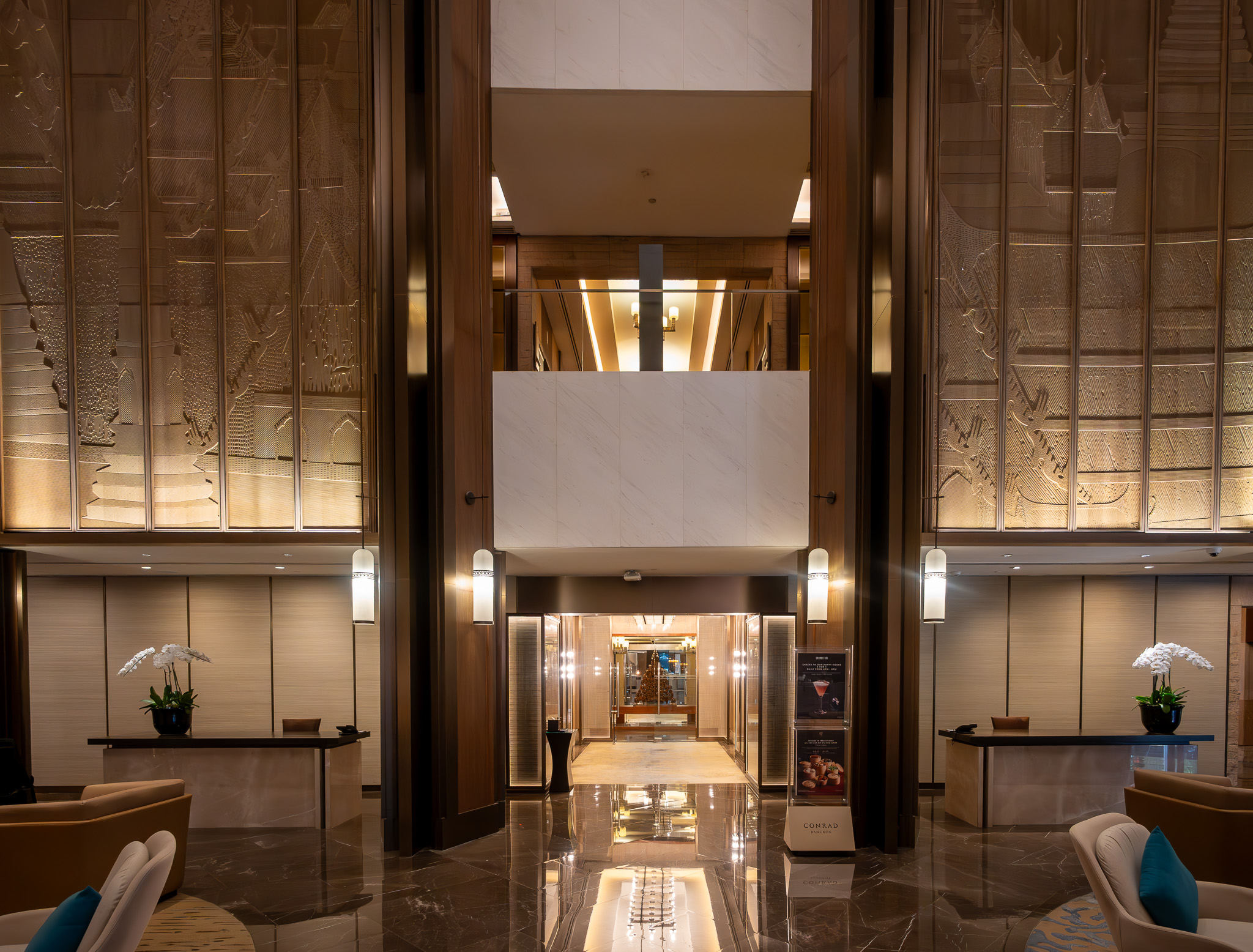
Inside, the shift was more pronounced. A three‑floor atrium lobby, cool and bamboo‑toned, swallowed the humidity from outside. Beige stone, large pillars, a broad staircase, and carved Thai wooden panels set the tone: Thai influences framed inside an international luxury vocabulary. This property opened in 2003, an era when Bangkok was defining itself as Asia’s great business‑leisure crossroads, and it went through a renovation of rooms and meeting spaces in 2018–2019 to stay competitive. My purpose here was to see whether that evolution has been enough, and whether a two‑decade‑old business tower can still feel relevant in a city filled with new luxury openings.
Over the next couple of days, I worked from a Grand Premium Room, tested the “7th Heaven” wellness floor at various hours, sat through breakfast at Café@2 both mornings, and ended one evening at Diplomat Bar. What emerged was a portrait of an established business hotel that understands its core clientele, layers in Thai touches with more restraint than flourish, and relies heavily on its seventh‑floor sanctuary to differentiate itself from younger competitors.
Wireless Road on Mute
Location determines how a Bangkok hotel behaves. On Wireless Road, Conrad Bangkok occupies corporate Bangkok rather than tourist Bangkok. The building is part of All Seasons Place, so the immediate surroundings are offices, cafés serving the lunch crowd, and retail that caters to people who work nearby. Walking out in the early evening, I passed suit jackets draped over arms and ID lanyards, not backpackers or late‑night revelers.
For an international business traveler, this makes sense. The embassies that line Wireless Road are close by, and several major corporate offices sit within short driving distance. Taxis and ride‑hail cars come quickly, and the traffic here, while still Bangkok, feels marginally less frantic than Sukhumvit’s more congested stretches. On both days, I found it easy to get cars at the hotel’s front drive without the elbowing one often encounters in denser nightlife areas.

Leisure access depends on your tolerance for short transfers. Conrad Bangkok runs a complimentary shuttle to Phloen Chit BTS station, which I used once to gauge practicality. The shuttle loops on a schedule that staff explained at check‑in, and the ride itself took only a few minutes. From Phloen Chit, the Skytrain puts Siam’s major shopping hubs, such as CentralWorld and Siam Paragon, comfortably within reach. Central Embassy and the Erawan Shrine are also quick rides away by taxi. If you want Sukhumvit’s dining and nightlife, Wireless Road connects easily by car.
There is also an appeal in having green space nearby. Lumphini Park and Benchakitti Park sit within short driving distance, so a morning or late‑afternoon walk is very feasible. That matters in a city whose density can exhaust visitors quickly. Conrad’s location is not for those who want to step out into a night market, but it suits travelers whose days revolve around meetings and whose evenings involve a deliberate choice of where, not whether, to go out.
A 2003 Tower in a New Suit
Conrad Bangkok’s architecture reflects its era: a sizeable tower, part of a mixed‑use complex, organized around an unusual octagonal footprint. Rooms encircle a central open void that houses the seventh‑floor pool and wellness deck, and that geometry shapes how you move through the building. My first trip from the lobby to the Grand Premium Room prompted a brief pause at the lift lobby as I studied the floor plan: the corridors trace the octagon around that open core. After a couple of circuits, it made sense, but the layout is distinctive enough to register.


The three‑floor lobby remains the property’s visual statement. The atrium height creates a volume of air that, in Bangkok’s climate, telegraphs relief. Pillars in pale stone, bamboo and beige tones, and carved Thai wooden art panels create a calm palette. The staircase that sweeps up from the lobby has the slightly theatrical scale old‑guard business hotels favor, meant for gala guests as much as regular check‑ins. In the late afternoon, lighting is warm and indirect, neither dim nor clinical, and the ambient sound is a mix of subdued conversation and the low background hum typical of large hotels.
The 2018–2019 renovation concentrated on guest rooms and conference spaces rather than a full architectural rethink. In the public areas you sense that duality. Corridors and meeting floors feel refreshed rather than reinvented. Materials introduced in the renovation, such as oak, teak, and brushed bronze with gold tones, appear as you move toward the lifts and into the lounge and conference levels. They bring a quieter, more contemporary sheen to what remains, fundamentally, a 2003 business hotel.

This design evolution matters in Bangkok’s current context. Compared with some of the city’s newest luxury openings, Conrad’s public spaces no longer read as cutting‑edge, but they have aged better than many peers from the same era. The Thai elements are not window dressing; the carved wood feels consistent with the country’s crafts tradition, and the bamboo hues echo climate and place. Yet the property stops short of becoming a themed Thai fantasia. It feels international in the way a Hilton‑affiliated, globally oriented hotel is expected to feel, with Thai motifs woven through rather than shouted.
Acoustically, the public spaces perform well. Even when check‑in lines form in the mid‑afternoon, noise does not ricochet unpleasantly around the atrium. Temperature control is effective without the overcooled blast some tropical hotels favor. These are small, practical aspects, but they separate comfortable long‑running properties from aging ones that cling to form over function.
Rooms Built for Sleep and Getting Things Done
The Grand Premium Room was my base, and it deserves its role as a featured category here. Entering, you step into a short hallway that leads into an open sleeping and living area, with the bathroom set off to one side. This is a classic business‑hotel configuration, but the recent renovation’s materials make the space feel current rather than generic.
Oak and teak are the dominant notes underfoot and in the furniture. Surfaces have a pleasing tactile quality, with brushed‑bronze details and gold accents that catch the light without veering into glare. The color palette stays in natural woods and soft neutrals, which allows the Thai touches in textiles and decorative elements to register without clutter. It is an international luxury idiom, but it acknowledges where you are.


Floor‑to‑ceiling windows run along one wall of the room, framing Bangkok’s skyline. In the early morning, filtered light came in soft and pale, never harsh, which made waking and working pleasant. Night brings a layered cityscape: towers, scattered neon farther away, and the glow of traffic. The noise insulation surprised me. Even with the city’s constant motion outside, the room stayed quiet enough that I could work on a laptop at the desk without distraction and sleep without resorting to earplugs. Air conditioning handled Bangkok’s humidity easily; I did a bit of adjusting the first evening to find a temperature setting that avoided the chill many hotels default to, then left it there.
The bed, with quality bedding and the kind of mattress you expect from an international five‑star, delivered what matters most: restful sleep. After the first night, I woke without the usual travel stiffness, which is not something I can say about every business hotel. Textiles are crisp and cool to the touch, with that clean cotton feel that signals proper laundering and maintenance.
From a business perspective, the room’s work setup is central. A proper desk sits near power outlets that are placed sensibly for charging phones and laptops. I spent a few hours there each day with a MacBook and phone on charge, and the Wi‑Fi remained stable throughout. This is a Hilton‑managed property, and the connectivity performed at the standard one expects from a global brand. The seating area, with a chair near the windows, works as a secondary workspace or reading spot, but the primary desk is where one will spend working time.


The bathroom layout uses sliding doors to maintain separation without carving up the room. Fixtures are modern, with sufficient counter space for toiletries. The shower controls were straightforward to use, and water temperature and pressure remained consistent. There is no attempt here at daring, boutique‑style bathroom theatrics, which is appropriate. This is a room meant to support business travel rhythms, not surprise you each time you step into the shower.
In sum, the Grand Premium category hits the target it aims at: a modern, clean, Thai‑inflected space that supports work and rest consistently. It does not compete with the most design‑forward suites in Bangkok, but it maintains international luxury standards two decades on, which, in this competitive city, is no small feat.
Service Tuned to the Suitcase Crowd
Conrad Bangkok is part of a global chain, and it behaves like it. Service is professional, consistent, and geared toward the needs of corporate and meetings travelers, who have historically made up a significant majority of its guests. Yet the cultural grounding remains Thai. Staff interactions tend toward warmth expressed through respect rather than overt familiarity.
Check‑in on that Thursday afternoon illustrates the approach. The front desk was busy, but staff managed the queue with quiet efficiency. English was spoken comfortably, as you would expect in a property serving guests from Hong Kong, Singapore, Taiwan, the United States, and beyond. The conversation covered essentials without fuss: explanation of Wi‑Fi, breakfast hours at Café@2, confirmation of access to the executive lounge with my room type, and a quick outline of the shuttle schedule to the BTS station. It was transactional in the best sense, not perfunctory.
Housekeeping impressed through timing and discretion. Returning to the room late morning after a session at the pool, I found it already serviced, with everything restored neatly and without the over‑perfumed air some properties favor. Turn‑down later in the day happened while I was out at dinner, which speaks to staff paying attention to guest movement patterns rather than knocking at inopportune moments. Laundry and pressing requests are available, though I did not send anything during this stay.


The concierge handled a restaurant query in the way I appreciate in business hotels: listening first, then offering a shortlist that matched criteria rather than just pressing the hotel’s own outlets. The conversation shifted easily among nearby options accessible via BTS and those better reached by taxi. Multilingual capability at the desk was evident, with staff switching languages with other guests around me.
Service in the executive lounge, which I visited briefly early evening, mirrored the rest of the hotel. Staff were attentive without hovering, and the atmosphere was more functional than lavish. Some guests will find the lounge perfectly adequate as a work and meeting space with refreshments; others, used to more elaborate offerings at newer properties, may consider it serviceable but unremarkable. In the context of an established business hotel, it does its job.
It is important to understand Thai hospitality traditions here. Staff maintain a degree of formality and distance that differs from American casualness. To my eye, this is appropriate, particularly in a district that serves embassies and corporate offices. I never sensed stiffness, only a professional respect for boundaries that aligns with both Thai custom and international business expectations.
Eating, Drinking, and Getting On with It
Conrad Bangkok runs six restaurants and lounges, though my focus fell naturally on those most relevant to business and short‑stay travelers. Café@2 serves as the all‑day dining venue and breakfast center, Liu and KiSara handle Chinese and Japanese cuisine respectively, City Terrace caters to the pool level, and Diplomat Bar is the primary lounge‑bar.
Breakfast at Café@2 both mornings reflected the property’s international clientele. I went down once early and once closer to the end of service to gauge variation. The room filled steadily with business travelers discussing meetings, a few leisure guests heading out to shop, and some who looked to be in town for conferences in the hotel’s 22 meeting rooms. Service was organized: coffee orders came quickly, plates were cleared unobtrusively, and staff kept the buffet areas tidy.

The spread itself covered the expected five‑star territory: Western breakfast staples, Asian options, fruit, and baked goods. What matters in these cases is less the sheer breadth and more the execution. Eggs and hot dishes arrived at the right temperature, and nothing lingered so long that it went dry. It felt like a breakfast program designed to send people into a full workday rather than stage an event in its own right, which is appropriate for this property.

An evening at Diplomat Bar provided a different view of the lobby level. The bar occupies a space that benefits from the atrium’s scale but carves out its own mood with lower lighting and more intimate seating zones. Cocktails and other beverages are served in a lounge setting that skews toward the corporate crowd: small group meetings, solo travelers with laptops, and pairs unwinding after work. Service was competent and prompt, and the drink list did what it needed to do. This is not a bar that defines the Bangkok night, but for a nightcap within the hotel before heading up to a Grand Premium Room, it functions well.
City Terrace on the pool deck supplies drinks and light food around the water. Late Friday morning, I ordered something light after swimming, and service came through with the relaxed pace that suits a tropical pool rather than a boardroom. It underlines how the hotel has tried to create a resort atmosphere up on the seventh floor while maintaining a business posture in the rest of the building.
I did not dine at Liu or KiSara on this visit, but their presence broadens the on‑site options for guests who prefer to stay within the complex after long days. For more adventurous or local dining, the BTS or a quick taxi will connect you to far more distinctive culinary experiences across the city.


Seventh‑Floor Sanctuary
For me, Conrad Bangkok’s defining feature is not its tower or even its lobby; it is the seventh‑floor “7th Heaven” wellness sanctuary. The hotel has bundled its outdoor pool, Seasons Spa, and BodyWorx fitness center into this single level, and the octagonal building’s open core allows this floor to function as a tropical courtyard suspended above the city.

Access is by elevator to around level seven, then a short walk through the spa and wellness zone to the outdoors. On stepping out, palm trees, deck chairs, umbrellas, and the geometry of the pool pull you out of office‑tower headspace. The main pool curves around the deck with a smaller whirlpool and a section that includes jacuzzi jets and a waterfall feature. The water temperature on Friday late morning felt agreeable in the heat, and the temperature‑controlled whirlpool delivered the gentle warmth one wants without becoming a hot tub ordeal in a tropical climate.
What struck me was the relative calm. Because the hotel’s location draws business travelers more than holidaymakers, the pool area avoids the frenetic energy one sees at some central city properties. Even mid‑morning, there were enough loungers free to choose between sun and shade. Towels sat at the entrance station, and staff handled requests without fuss. From certain angles on the deck you see the city’s buildings beyond the palms, which reinforces the sense of being in an urban sanctuary rather than a remote resort.

BodyWorx, the fitness center, sits adjacent. I went in early on the second morning, before breakfast, and found modern cardio machines and free weights in a layout that supported a functional workout rather than a design statement. For a property that serves meetings and conferences, a 24‑hour gym is essential, and Conrad Bangkok meets that requirement. Scheduled classes such as yoga and step aerobics appear on the program, an additional nod toward travelers wanting structure around wellness. Equipment was clean, working, and available; I did not have to queue for any machine.
Seasons Spa, integrated into the 7th Heaven level, includes 11 themed treatment rooms along with a Japanese‑style tub and a steam room in the wellness center. A massage there one afternoon demonstrated why this kind of facility matters to road‑weary travelers. The therapists worked with quiet professionalism, and the environment maintained the same calm as the pool deck, an effective counterbalance to days spent in conference rooms or taxis.
Beyond wellness, Conrad Bangkok underscores its business orientation through its 22 meeting and conference rooms and the large, pillarless Conrad Ballroom. This ballroom can host large events, including receptions for around 1,200 standing guests, and features one of the larger LED screens in Thailand. Even if you are not attending a conference, you sense the scale: groups moving between breakout rooms, signage for corporate events, and catering trolleys moving through back corridors. The hotel has built an operational infrastructure for corporate events over two decades, and it shows.
Outdoor tennis courts, recently complemented by pickleball courts and even a rooftop jogging track, round out the facilities. These are not decorative; I saw courts in use during the late afternoon. For guests staying longer or those from markets such as Hong Kong or Singapore, where tennis and racket sports remain popular, this will be a draw.


Holding Its Ground in a Flashy City
Bangkok’s luxury hotel market has become more crowded and more sophisticated since Conrad Bangkok opened in 2003. New properties have entered with striking architecture, bold design, and aggressive pricing. Against this backdrop, an established business hotel has to justify its rates through reliability, service standards, and differentiated facilities.
Conrad Bangkok positions itself firmly in the luxury segment. It carries a five‑star profile on major platforms and belongs to the Conrad Hotels & Resorts portfolio under Hilton Worldwide, which means Hilton Honors members can earn and redeem points here. For frequent business travelers, that loyalty integration often tips choices, and in this case it adds tangible value, particularly for those who attend multiple conferences at the property or in the area.
From a value perspective, the Grand Premium Room feels like an intelligent choice within the property’s offerings. You receive the benefits of the 2018–2019 renovation in a generously scaled room that supports work, rest, and city views without paying for suite excess you may not use on a business‑oriented stay. Executive‑level rooms grant access to the sky‑high executive lounge, which adds value for those who regularly hold informal meetings or prefer breakfast and evening drinks in a more private environment than the main restaurant, though some travelers may find the lounge’s offering competent rather than exceptional compared with lounges in Bangkok’s newest flagships.
Where Conrad Bangkok distinguishes itself in the value equation is the 7th Heaven wellness floor. For business travelers, the integrated pool, spa, fitness center, tennis and pickleball courts, and jogging track turn what might otherwise be a straightforward conference hotel into something closer to an urban resort. The ability to swim in a palm‑framed pool, have a massage, then walk a few minutes back up to a Grand Premium Room ready for a late‑afternoon video call is precisely the kind of combined functionality many modern corporate travelers want.
Those whose primary goal is leisure tourism, especially first‑time visitors wanting immediate immersion in Bangkok’s street life, might find newer properties directly on the river or in tourist‑dense parts of Sukhumvit more compelling. Some of those hotels present fresher, more dramatic design and positions closer to nightlife. But they may not match Conrad’s conference infrastructure or its quiet, embassy‑district poise.
In this context, Conrad Bangkok justifies its pricing most strongly for corporate and meetings‑driven stays, for Hilton‑loyal guests, and for travelers who value a calm base with serious wellness facilities over proximity to bars and markets. For those groups, it remains a solid proposition.
So, Who Is This Really For?
Conrad Bangkok is, at heart, an international luxury business hotel that has wrapped itself around a genuine wellness sanctuary. The Wireless Road location, in a quieter diplomatic and office district, suits its primary audience: business travelers, corporate groups, and embassy‑related visitors who want proximity to meetings and reliable transport links to shopping and dining rather than immediate immersion in tourist zones. The hotel’s 392 rooms and suites, particularly the renovated Grand Premium category, maintain a standard of comfort and functionality aligned with what global travelers expect from a Conrad‑branded property.
Design‑wise, this is a tower from 2003 wearing a well‑judged 2018–2019 wardrobe. The Thai elements in wood carving, materials, and palette feel respectful rather than ornamental, and the public spaces have aged more gracefully than many contemporaries. The hotel does not pretend to be a design icon; it aims to be appropriate, comfortable, and culturally grounded enough to remind you that you are in Bangkok, not in a placeless international bubble.

Service follows Thai hospitality traditions adapted for an international, often Asian, corporate clientele. Staff are multilingual, professional, and practiced at handling the logistics and expectations of conferences and frequent travelers. The infrastructure for meetings is robust, from the pillarless ballroom with its large LED screen to the numerous breakout rooms and on‑site planning support.
The defining advantage, however, is the 7th Heaven floor. That seventh‑floor terrace, with its tropical pool, Seasons Spa, BodyWorx fitness center, tennis and pickleball courts, and jogging track, turns what might be a purely functional business hotel into a property where one can decompress meaningfully between obligations. In a city where new luxury towers compete loudly on design and amenities, Conrad Bangkok’s wellness sanctuary remains a quiet trump card.
Who should book? International business travelers, corporate event attendees, and Hilton Honors loyalists looking for a reliable, well‑run base in Bangkok’s business district will find Conrad Bangkok suits their needs. Travelers who place a premium on a serious gym, spa, and pool in a business context will appreciate what 7th Heaven offers. Guests whose main aim is leisure exploration, cutting‑edge design, and immediate access to nightlife may find newer, more flamboyant properties either on the river or deeper into Sukhumvit more exciting.
Two decades on, Conrad Bangkok has not reinvented itself as something radically new. Instead, it has refined its core strengths: dependable rooms, culturally aware service, conference capacity, and a wellness deck that still feels like a discovery when you step out among the palms and look back at the city. For an established business hotel in a hyper‑competitive market, that kind of measured, maintained standard is exactly its point.