






Treeful Treehouse Sustainable Resort Okinawa Review






The first thing to go quiet wasn’t the road noise or city glare. It was the part of my brain that tracks bars, convenience stores, and backup plans. As the car slipped off Okinawa’s coastal strip and into Yambaru’s interior, the forest closed in, the river slid into view, and the world narrowed to greens, gradients, and a sense of going somewhere you don’t just stumble across. Treeful Treehouse Sustainable Resort sits out here in Nago City at 2578 Genka, above and alongside the Genka River, and it introduces itself less like a hotel and more like a small, deliberate intervention in a living ecosystem.

Treeful frames its purpose as coexistence with nature and a sustainable world, and it pushes that idea through architecture: elevated treehouses meant to avoid disturbing the ground, paired with more fully equipped Aero Houses that make the whole thing livable. The question is whether the concept reads as eco-theater or as a functional, high-end way to disappear into the forest. Over a couple of winter days, I found it closer to the latter, with a few real trade-offs that Treeful doesn’t try to fully cushion.
Roads, River, and Choosing Remoteness
Treeful works because of where it is, and also because it asks you to accept where it is. This is northern Okinawa, not a beachfront resort strip. The approach felt increasingly secluded as the car moved into denser canopy and the road asked for more attention. It’s a place that expects self-drive travelers, with free private parking on site, and that detail matters: arriving by car makes the logistics of supplies and dinner ingredients more natural. Arriving by ride, like I did, makes the remoteness more pronounced the moment the car leaves.


On arrival in the early afternoon, the property’s layout registers in fragments. There’s a parking area, then paths that pull you away from the vehicle and into a riverside landscape of trees, planted areas, and structures raised above the ground. The resort doesn’t soften the fact that the forest is the neighborhood. That’s the point.
This is also not a casual pop-in stay. Reservations require at least five days before arrival, and upper floors are accessible only by stairs. Treeful is physically and operationally selective. If that sounds like friction, it is. If it sounds like focus, it is that too.
Suspended Design Without the Theme Park Energy


Treeful markets its buildings as suspended architecture that minimizes impact on the ground, and in person the strongest argument for that claim is simply what you don’t see: heavy footprints, broad paving, the usual flattening of a site into something “resort-like.” The treehouses are elevated, and that decision reads as both ecological and experiential. You feel the forest underneath you instead of under your shoes.


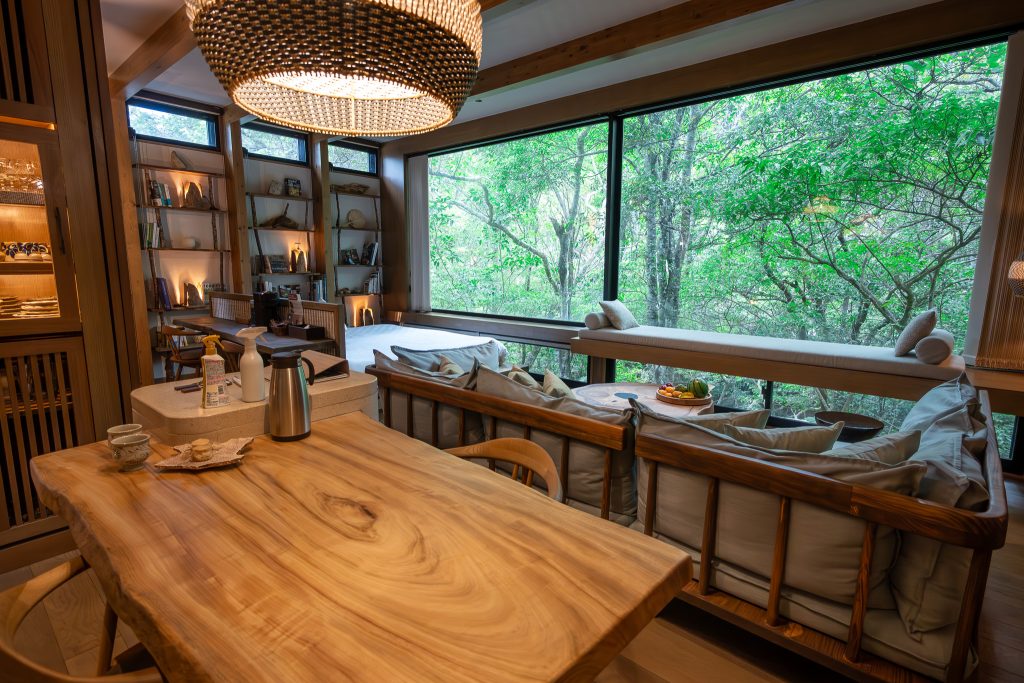
The design language leans into wood and restraint. Inside the residential structures I saw hardwood or parquet flooring and a general warmth that comes from real material rather than decorative styling. Large windows pull in the Yambaru greens, and the overall impression is that the interiors were designed to harmonize with the setting instead of competing with it. It’s not a jungle fantasy. It’s a set of small, modern rooms that know where they are.


The suspended form also changes your sense of stability in a subtle way. In the treehouse, you’re aware you’re up, not out. The view lines feel lifted toward river and canopy, and sound follows: the outdoors arrives as texture, not as background wallpaper. Treeful’s design succeeds when it accepts that comfort doesn’t have to mean separation from nature. It falters only when you want the buildings to do more than they’re sized to do.
One Stay, Two Structures, Two Tempos
Treeful’s defining move is its dual-structure accommodation model. The resort’s stays center on pairings: a treehouse coupled with an Aero House. The room mix is straightforward but conceptually unusual: Aero Treehouse as a standalone unit for two guests with a minimum two-night stay, and three pairings designed for larger groups, each recommended for up to six guests: Spiral Treehouse with Aero House No.1, Golden Trophy Treehouse with Aero House No.2, and Halcyon Treehouse with Aero House No.3. The paired suites are two-bedroom configurations listed around 58 m², 72 m², and 88 m², while the smaller standalone double room category is listed at around 17 m².


I stayed in Aero House 3 coupled with the Halcyon Treehouse, and the first hour was mostly about learning circulation. You don’t just walk into a room and settle. You choose a base. The Aero House is the practical anchor: private entrance, living area with seating, a desk for work, and a fully equipped kitchen with stovetop, oven, microwave, refrigerator, coffee machine, electric kettle, kitchenware, and wine glasses. Storage is here too, via closets and wardrobes. My luggage lived in the Aero House because it’s the only place that feels designed for living rather than perching.


The Halcyon Treehouse, by contrast, read as a retreat with a purpose. Smaller, elevated, and intentionally limited, it’s where I went to read, listen to the river and insects as daylight dropped, and nap with the forest pressed close. The separation between structures, connected by paths and walkways, adds daily movement: coffee and planning in the Aero House, a midday reset in the treehouse, then back again when it’s time to cook, shower, and put the day away.


Architecturally, it’s a smart division of labor. Functionally, it can complicate a stay if you want hotel convenience. You’re always carrying something, even if it’s just your phone, a layer for the evening, or a cup of tea.
Off-Grid Ease, On-Your-Own Nights
Treeful is off-grid and carbon neutral, powered by solar panels and designed to operate without fossil fuels. In practice, that ambition lands best when you forget about it. Most of the time I did. Lights worked, climate control was steady, and modern basics like Wi-Fi were present. Rooms are described as having free Wi-Fi and mobile hotspot devices, and I found myself gravitating to the Aero House for connectivity and desk time, treating the treehouse as the place where being slightly less connected felt like the point.


Water comes from an on-site well sanitized by UV light for safe consumption. That’s a serious operational choice, and it’s also intimate. You taste it in tea, you feel it in the shower’s temperature consistency, and you recognize that “sustainable” here isn’t a sign in a hallway. It’s infrastructure.
Then there’s the service reality that defines the emotional tone after dark. Treeful offers private check-in and check-out, concierge services, and during staffed hours it feels polished and attentive. But staff are not on-site overnight, and guests may be alone after 20:00. The first evening, the departure of staff registered like a door closing in the distance. The property became quieter, more private, and more entirely mine to manage.


That can feel liberating if you want isolation. It can also sharpen small anxieties. What if you can’t figure out an appliance setting? What if you misjudge the path lighting? Treeful’s model assumes a capable guest, and it doesn’t pretend otherwise. That said, staff do walk you through the on-site emergency phone during check-in, should true need arise.
Firelight Dinners, Minimalist Mornings


Food at Treeful tells you what kind of place this is: a resort that offers dining, but also expects self-sufficiency, especially in the Aero Houses with full kitchens. There is an on-site restaurant, and breakfast is offered with simple, high-signal items like fresh baked breads and jams. In the mornings, I appreciated that the day didn’t begin with a sprawling buffet performance. It felt in character with a property that wants your attention outside, not hovering over chafing dishes.
 The most memorable meal was the bonfire dinner at the outdoor fire space, an arrangement that is limited to three groups on a first-come basis. It’s the kind of operational detail that matters because it reveals scale. Treeful isn’t trying to feed a crowd. It’s trying to create an evening that fits the forest. That night included vegetable dumplings, rice, and an assortment of steamed veggies, served in a way that kept the boundary between restaurant and campfire intentionally blurry. The fire space is not a stage set. It’s outdoors, close enough to the river environment that you remember you’re eating in a habitat, not beside a pool deck.
I also kept returning to the Aero House kitchen, partly because it’s there and partly because cooking is a form of settling in. Treeful can provide packed lunches as a service, but the broader message is consistent: you’re not here for constant delivery. You’re here to participate.
Forest Wellness You Have to Earn
Treeful’s activity offerings are extensive, but they aren’t filler. The resort’s “How to Spend Your Time” and “Activities” sections reflect a property that understands its best amenity is the Yambaru environment itself, with optional experiences that put you in contact with river, forest, and coastline. Verified options include guided river trekking, forest-bathing river trekking, walking tours, a restarted Yambaru scenic tour, and a clear kayak tour on the sea. There’s also a wedding photo or photo wedding plan, plus space rental that suggests event use.
On-site, the most physical invitation is the river. There’s a slide leading into the water that makes the resort’s relationship to the Genka River direct and slightly playful, and it sets expectations: this is a place for guests comfortable around moving water and outdoor conditions.


I did the waterfall basin sauna once, and it clarified Treeful’s version of wellness. This isn’t a sealed spa world. It’s a sauna experience that keeps the forest present, reinforced by the resort’s sauna with a transparent window looking out onto trees. The ritual is simple: heat, then cold immersion in the water, then repeat until your sense of time loosens. It felt close to the site rather than imposed on it, more like an organized access point to something already there.

Treeful also offers relaxation services including aromatherapy and massages, with sessions that can focus on head, neck, hands, back, feet, or full body. The resort’s general facilities extend to gardens, a terrace, outdoor furniture, and picnic areas, all of it designed for lingering rather than spectacle. Even the practicalities are explicit: the property is smoke-free with a designated smoking area, and security infrastructure includes alarms, smoke detectors, fire extinguishers, key access, and CCTV outside.

The wild card is wildlife. The resident goat, Donna, moved through the property with the confidence of someone who pays no rent, appearing near paths and outdoor areas. She’s charming, until you remember animals and parked cars share the same space. Insects are part of the deal too, especially around the treehouses. I found it tolerable, but it’s not optional. Treeful is honest about being in a biodiverse, subtropical environment, and it doesn’t hermetically seal you from that fact.
Rethinking Five Stars in the Forest


Treeful is listed as a five-star property, and it positions itself in the upper-mid to luxury segment of Okinawa lodging. The value argument rests on three things that conventional luxury resorts can’t easily replicate: being in Yambaru, being above a river, and being built around suspended, low-impact architecture with off-grid operations. If those are your priorities, the cost starts to make sense because you’re paying for a form of access and a form of privacy, not for an endless menu of services.


Still, eco-luxury here has a specific definition. It means solar power and well water with UV sanitization, modern amenities without fossil-fuel dependence, and a design that doesn’t bulldoze the site into submission. It also means you may be managing your own evening rhythm, with no overnight staff presence after 20:00, and you may be cooking some meals yourself even when you’re staying at a high-end property.
Treeful makes the most sense for travelers who like design with a purpose and who don’t need constant staff visibility to feel cared for. It works for couples and small groups who want the dual-structure model to create a shared base and a separate retreat. It’s less suited to anyone who equates luxury with 24-hour room service, abundant on-site dining choices, or the certainty that every minor problem will be solved immediately by someone in uniform.
Compared with more conventional Okinawa luxury resorts, Treeful is narrower and more intense. That is its strength, and also its filter.
Final Takeaway
Treeful Treehouse Sustainable Resort is a rare property that commits to its concept all the way down to how you carry your day. The paired Aero House and treehouse model isn’t a gimmick. It’s a spatial argument: live comfortably in one structure, then step out of it to breath closer to the forest in the other. That separation creates privacy and rhythm, but it also adds friction, especially if you want hotel life to be contained within one door.

The suspended architecture does what it promises in the way that matters most. It keeps the site feeling like Yambaru, not like a cleared platform for a resort. The off-grid systems, from solar power to UV-sanitized well water, register as functional infrastructure rather than a marketing layer. The trade-off is service style. Private check-in, concierge support, and careful orientation can’t fully disguise the fact that after 20:00, you’re self-sufficient.
Book Treeful if you want sustainable design you can actually inhabit, and if you’re comfortable sharing space with insects, river air, and a lovely goat wandering the paths. Skip it if you need constant staff presence, polished resort dining every night, or a version of luxury that insulates you from nature.