






Southwest Grand Hotel Okinawa Review




The heat hit first. Midday in Naha, taxi door still swinging shut, the air felt dense with traffic, shop neon, and the low roar of Kokusai Street a block away. For a second, I couldn’t even pick out the entrance—no sweeping driveway, no “you’ve arrived” choreography—just a modest drop-off that belonged to the city more than to any one building. Then the doors closed behind me, the volume dropped, and it was clear what Southwest Grand Hotel is actually selling: height, silence, and a city view instead of a shoreline.
This is a 12-story building that opened on June 20, 2023, positioned as a luxury city hotel in Naha, often treated in the market like a five-star. Its central idea is simple: give you a design-led base in town, with enough space and facilities to feel like a destination even when you never see a beach.
Kokusai Street at Your Door, Airport at Your Back

Southwest Grand Hotel sits at 3-29-52 Kumoji, Naha City, Okinawa Prefecture, and the address behaves the way you want an urban hotel address to behave. It’s about a one-minute walk to Kokusai Dori, which means dinner is never a plan. It’s just a left turn and a decision. On my first evening, I walked out and immediately hit the current of central Naha: souvenir shops, restaurants, bars, entertainment, the constant switch between bright interiors and humid street air. Then I walked back and the building went quiet again, which is the hotel’s best trick.
From the airport, it’s roughly a 12-minute drive under typical traffic. By monorail, the hotel is within walking distance of Kenchomae and Miebashi stations, so you can move around the city without committing to a car. If you do drive, paid parking is part of the equation, though on-site parking may be limited and you may end up using nearby paid lots. That friction fits the location: this is central Naha, not an all-inclusive compound.
Mid-Century Mood, Ryukyu Underpinnings


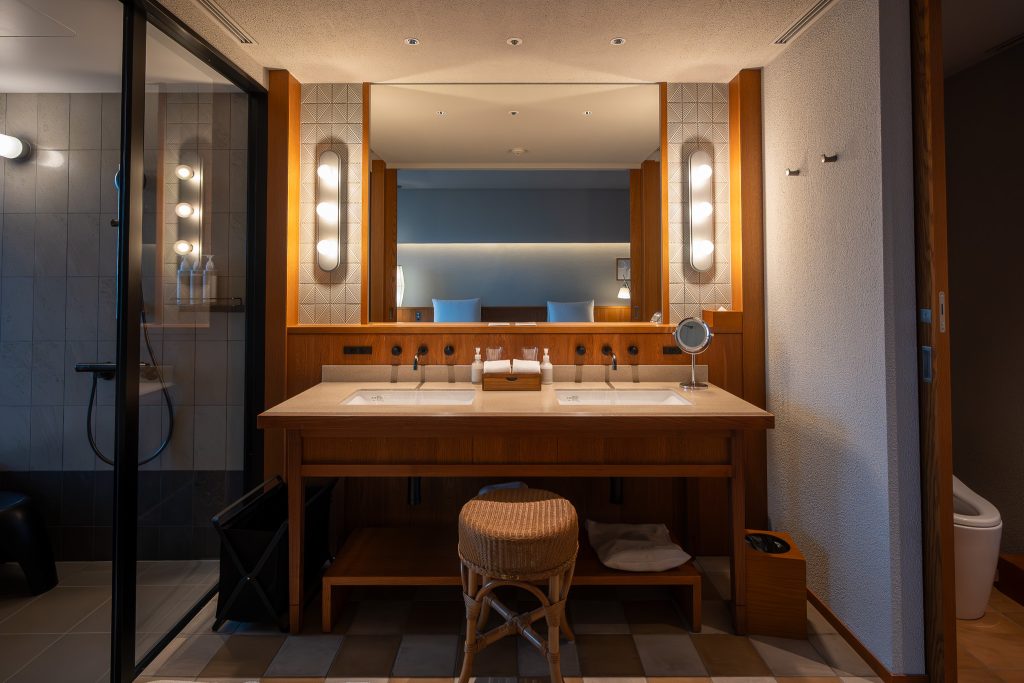
The hotel’s interiors lean on a specific hybrid: mid-century American design filtered through Okinawa’s Ryukyu-American cultural blend, sometimes framed as Ryubei culture. In practice, it reads less like a themed set and more like a consistent palette that’s been held to across rooms and public spaces. Warm wood tones show up where your hands and feet actually meet the building, and I appreciated that directness. I’m skeptical of trend-forward hotels that try to manufacture “culture” through a few graphic gestures. Here the concept is integrated enough that it fades into function.


Circulation is straightforward, which sounds like faint praise until you’ve stayed in too many design hotels that make you work for the elevator. Light is the other organizing material. Between the vertical structure and the hotel’s downtown position, you’re constantly oriented by the city outside, not by interior spectacle. Even the quieter areas keep a sense of where you are in Naha, which is the point. This isn’t a beach resort pretending it belongs in town. It’s a city hotel that admits the city is the attraction.
Room Categories, Real-Life Balconies
The accommodation structure is cleanly defined: 87 guest rooms across five room types. At the top sits a Penthouse Suite on the 12th floor, described as combining interior space and terrace for up to approximately 150 square meters, with a kitchen, living and dining area, and two bedrooms. There’s also a single Terrace Suite with an approximately 16-square-meter terrace and a glass-walled bathroom positioned for views day and night. The lineup rounds out with Balcony Twin rooms, Corner King rooms with windows on two sides, and Grand Twin rooms of approximately 45 square meters designed for long stays.


I stayed in a Balcony Twin, and the first impression was volume. The plan uses an open layout with few partitions, so the room reads larger than a typical city hotel even before you step outside. The wood flooring helps, both visually and underfoot, and it also comes with the trade-off you’d expect: late evening, I could catch traces of sound from nearby rooms or floors, footsteps and movement that wouldn’t matter to everyone but will matter to light sleepers.


I opened the windows, which you can do here, and the room shifted from sealed hotel neutrality to actual air and city noise. By the next morning, I’d settled into the rhythm: coffee and laptop near the window, doors cracked for a few minutes, then closed again when the street energy started to dominate. The bathroom followed the hotel’s contemporary line, with a separate wet area and modern fixtures, more functional than showy. For two people, it works because the space planning stays honest.
Warm Service, Unhurried Front Desk

Check-in starts at 15:00, and arriving earlier than that can reveal a hotel’s personality. I got in around noon, and the front desk was friendly in tone but not perfectly efficient in execution. Nothing dramatic, just the mild procedural drag that happens when a property is aiming for polish and still smoothing out its internal choreography. Once it clicked into place, the orientation was clear and the keys were handed over without fuss.
The service style reads as a blend of Japanese omotenashi and Okinawa’s international history, which is how the hotel frames its own appeal. In lived terms, that meant warmth without performance. When I asked a quick question about getting around by monorail, the help was direct and useful, the kind of interaction that saves you ten minutes of wandering later. Housekeeping also matched the hotel’s reputation for cleanliness. Mid-morning, there was the brief, practical exchange that tells you a lot: a knock, a refresh, the room returning to baseline without feeling invaded.
It’s also a family-friendly property, and it doesn’t accept pets. Those policies shape the building’s social tone. The atmosphere stayed quiet and private while I was there, despite being so close to the busiest commercial street in the city.
Four Restaurants, One Okinawan Morning


Southwest Grand Hotel runs four dining venues, and they’re positioned as part of the hotel’s identity rather than an afterthought. The all-day dining restaurant, A LONG VACATION., anchors the offering and also supplies dinner through room service, which I used once after a long walk when the idea of choosing among Kokusai Street’s options felt like work. The operation feels designed for people who want the city outside but don’t always want to re-enter it.
The Japanese restaurant is SHIKAKU, and the teppanyaki counter is Steak House Matsuo. The upper-floor component is The Sailor’s Club, described as a barbecue restaurant and sunset bar paired with the high-floor indoor pool. Teppanyaki here is framed as cuisine-forward rather than theatrical, which I respect. Fire tricks age quickly. Good cooking doesn’t.


Breakfast is the meal that most clearly ties the hotel to Okinawa. It emphasizes variety with plenty of Okinawan ingredients, served in a room with large windows that pull in morning sun. On my second morning, I took a window table and built a small routine out of the specific local touches: kachuyu miso, and the customizable seafood bowl ingredients that let you steer your own plate. Breakfast is typically offered as an optional add-on with an additional charge, and the value question is real in a neighborhood where you can eat well outside the hotel within minutes. The execution is strong. The decision is whether you want convenience and consistency, or the city’s spontaneity.
Elevators to the Amenity Deck

The hotel’s facilities are organized vertically, and the concentration point is the 11th floor. The indoor pool is up here, exclusive to hotel guests, with panoramic views across downtown Naha. It’s visually attractive, especially when the city light starts to soften, but it’s also compact. This isn’t a lap pool you train in. It’s a pause, a temperature change, a place to float and look outward for half an hour.


Adjacent to that is the outdoor jacuzzi, and the hotel explicitly frames it around the sunset. I visited it at the obvious time, and the combination worked: warm water, wind you can actually feel at height, the city shifting into evening. In a beach region, this is the hotel’s substitute for shoreline ritual, and it lands better than I expected.

The gym is also part of the guest-only lineup, equipped with NOHrD, the German-made wooden fitness machines that read like furniture and feel like equipment. Even if you don’t train seriously, the material choice matters. Wood changes the room’s tone. There’s also a guest lounge within the property and a coin laundry, both small but practical signals that the hotel is thinking about longer stays, not just weekend check-ins. Above it all, the 12th-floor Penthouse Suite is the only category with direct access to the swimming pool and sauna area, a private shortcut built into the hotel’s vertical logic.
Paying for Air, Light, and Naha

Southwest Grand Hotel sits at the upper end of Naha city hotel pricing, and the value pitch depends on what you think “luxury” should buy in an urban Okinawa context. You’re not paying for beachfront acreage or sprawling resort grounds. You’re paying for space, design coherence, and a controlled interior world that still keeps the city in frame through large windows and skyline views.
The rooms help make the case. Standard rooms are described as more than 45 square meters, which is generous for a city property, and the open layouts with minimal partitions amplify that generosity. The building’s functional set also supports the price logic: an indoor pool and outdoor jacuzzi with panoramic views, a fitness center with distinctive equipment, a lounge, coin laundry, and four dining venues, all stacked into a compact 12-story footprint.
There are practical costs and constraints that can affect the calculus. Parking is paid and may be limited, and the entrance by car can take a moment to find. Breakfast, while well executed, can feel expensive next to the local alternatives a minute away on Kokusai Dori. For travelers who want Okinawa to look like Okinawa without leaving town, those trade-offs are acceptable. For anyone hunting for resort scale, they’ll feel like a mismatch.
Final Thoughts

Southwest Grand Hotel is best understood as a deliberate argument for staying in Naha like it’s a city worth inhabiting, not just a transit stop on the way to the beach. The building’s character comes from its vertical organization and its spatial confidence: open-plan rooms, wood flooring, large windows you can actually open, and amenities placed high enough that the skyline becomes part of the program. The mid-century American and Ryukyu-American fusion could have turned into decoration. Instead, it mostly supports livability, a consistent material warmth that holds up when you’re working at the desk, rinsing off in the wet-area bathroom, or resetting your brain in the pool.
Book it if you want central access and a luxury-standard room that feels sized for real life, with Kokusai Street as your dining hall and the 11th floor as your reset button. Skip it if you’re coming to Okinawa for the geometry of a resort: long paths, big water, the engineered illusion of escape.