






Oriental Hotel Okinawa Resort&Spa Review




You don’t come here to disappear. You come up that last curve in the road, see a coral-pink high-rise on a green slope, and understand immediately that this is a resort built to be seen as much as stayed in. The drama is urban in scale, even though the backdrop is subtropical forest and sea. Oriental Hotel Okinawa Resort & Spa sits at the entrance to Yambaru, the northern zone known for subtropical forests and coastline, and it operates like a base camp with air conditioning and logistics.
The question I carried inside was simple. After running as a Marriott franchise until the 2021–2022 era, and rebranding around the COVID period, has the hotel actually been rebuilt in spirit, or just re-labeled? Over the next couple of mornings and nights, the answer landed somewhere in the middle, in a way that felt honest for a 361-room resort tower.
Gateway Geography, and the Car-Shaped Reality
Nago City isn’t a place you “stroll” the way you might in a dense neighborhood hotel review. This property’s advantage is positional: it’s a short drive from Kyoda Interchange on the Okinawa Expressway, so the hotel becomes a hinge between Naha access and northern exploration. About 60 minutes by car from Okinawa Churaumi Aquarium and around 20 minutes by car from Manzamo in Onna Village, you can play the island from this one address without committing to an isolated northern outpost.
But the strategy assumes wheels. There’s an airport shuttle bus on a scheduled basis, and the hotel has a beach shuttle that clearly exists, yet the rhythm still reads as car-forward. On my first evening, I asked the front desk about the beach shuttle and got a helpful explanation, plus the implicit caveat that it can feel thin in low season. Parking is there, uncovered, self-park, paid, and set up on a per-stay fee with in-and-out privileges. Translation: this is a rental-car hotel that will tolerate your attempt not to have one.
Renovation as Re-Positioning, Not Reinvention


The building itself dates to around 2005, and it still carries that era’s core move: concentrate everything into one large tower so the resort can run efficiently. You feel that efficiency immediately in the public circulation. The lobby has been updated into an open-air style Lobby Lounge environment, the kind of space meant to hold both afternoon tea and evening cocktails without switching costumes. The soundscape is social but controlled, and the open-air quality makes the humidity feel like a design parameter, not a flaw.
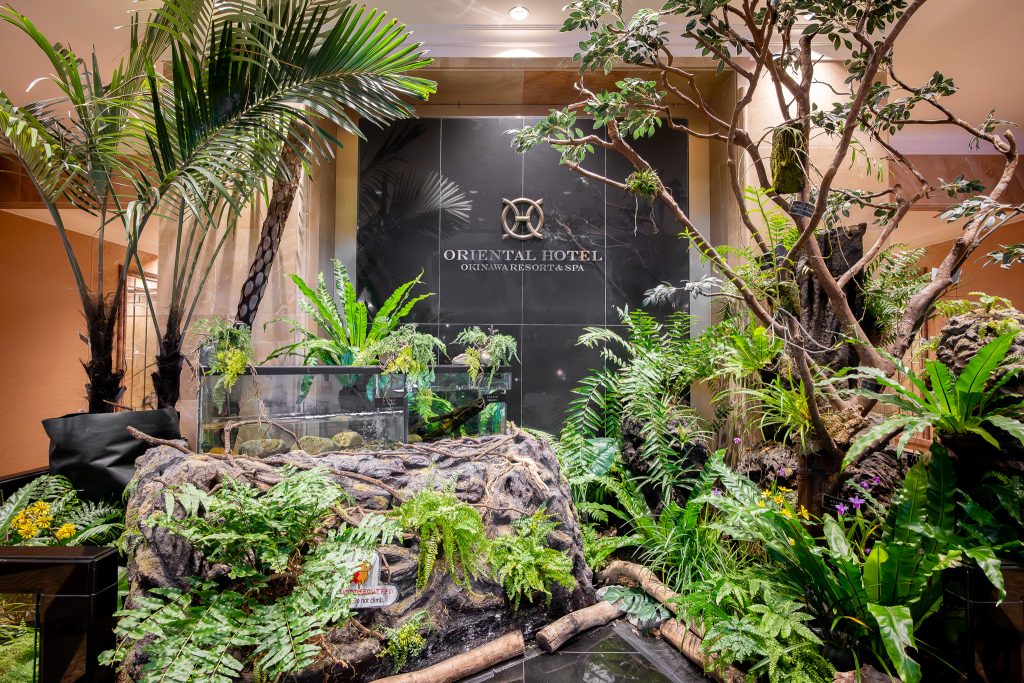
Oriental says it renovated over three years, touching the lobby, Club Lounge, Garden Pool, and guest rooms, with the completion announced on April 23 of a recent year. You can read that renovation in the way the ground floor now tries to translate “Love Okinawa Discover Yambaru” into surfaces and pacing. The stronger moments aren’t literal. They’re spatial: seating oriented to light and view, a relaxed threshold between inside and outside, and a public realm that can absorb family traffic without feeling like a food court. The weaker moments are the ones you can sense were layered onto an existing machine. This was a re-tuning, not a rebuild.
A 361-Room Tower Where Space Is the Luxury (Club Room Reality)
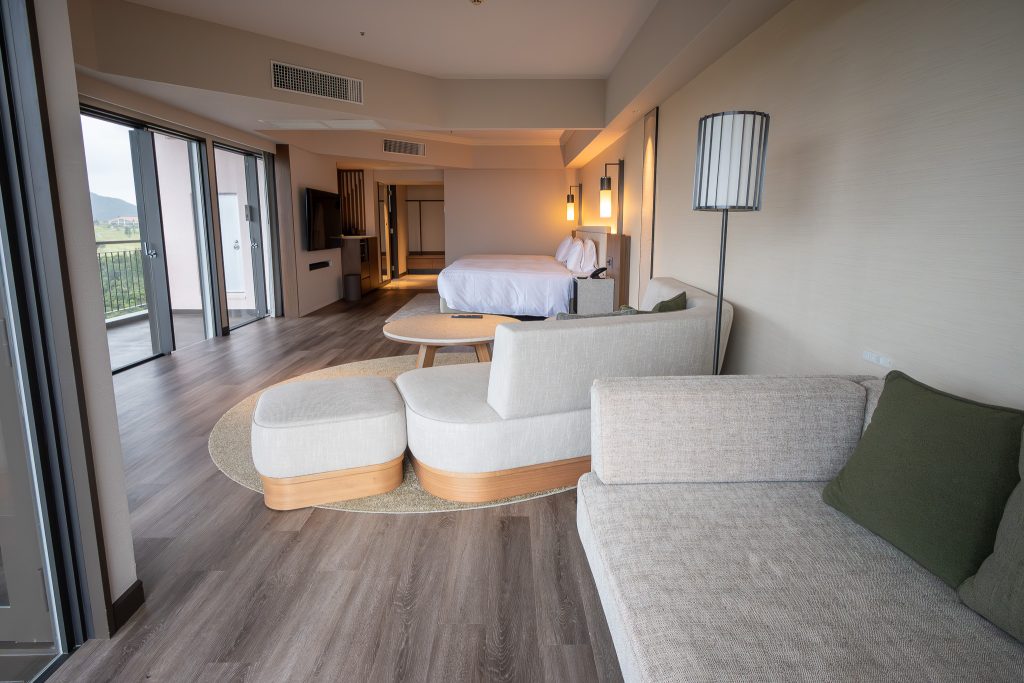
Before you get poetic about views, it helps to pin down what the accommodations actually are. Oriental Hotel Okinawa Resort & Spa has 361 rooms, and the hierarchy starts with Superior Rooms as the standard category. Those are approximately 45 square meters, with floor-to-ceiling windows and an inner terrace intended to frame Yambaru. All guest rooms have an ocean view from a private balcony, looking out toward the East China Sea with the hills of the north in the periphery. Club Rooms sit above that baseline by adding access to the Club Lounge, and suites rise to a front apex condition where the building’s V-shape meets. Those panoramic suites get balconies on both sides for a wider sweep of ocean.


I stayed in a Club Room, and the first impression was scale. In Japan, 45 square meters is already generous; the planning matters more than the number. Here, the room used its footprint sensibly: a clear entry sequence, a living zone that didn’t pinch the bed area, and enough real circulation that two people wouldn’t do that awkward sideways dance around luggage. The balcony was functional, not decorative. Late afternoon, I actually used it, which is my test for whether an outdoor space is real or just a checkbox. Minor friction showed up in a predictable way: the first walk to the Club Lounge took me longer than it should have, because big towers hide their premium layers in plain sight.


The property also states it has 36 Universal rooms, described as the largest number of universal design rooms in Japan. They’re located on floors 5 through 13, about 46.3 square meters, designed for wheelchair accessibility. In a resort this large, that commitment reads as operationally serious, not symbolic.
Service That Feels Trained, Then Human


A hotel can rebrand its signage in weeks. It takes longer to rebrand its service habits. Here, the operation still carries the muscle memory of a large international franchise, in a good way. The front desk runs 24 hours, multilingual staff are available, porter services exist, and the concierge layer is active rather than ornamental. That all sounds basic until you watch it work at scale.
On arrival, the check-in flow felt practiced. My bags disappeared with a bellhop’s efficiency and reappeared without drama, which is the kind of invisible success resorts should aim for. Later that first evening, I stopped back at the desk to confirm the beach shuttle timing. The answer was clear, and the tone was direct, not scripted. A different moment landed the next day when I asked the concierge for help thinking through dinner plans on property. The hotel has enough venues that you can accidentally waste time wandering, so the value of a staff member who can translate the building into decisions matters.
Housekeeping, too, had that large-hotel steadiness: present when needed, quiet when not. The result is service that doesn’t pretend to be intimate. It aims for reliable, calm competence, which is the right posture for a 361-room resort.
Breakfast as a Mission Statement (and Dinner as Logistics)
Buffet & Grill QWACHI serves the daily breakfast buffet, typically set between 7:00 a.m. and 10:00 a.m. for a fee, and it’s the meal that tells you what kind of resort this is. The room is designed for volume without feeling like a cafeteria, and the buffet flow is the real test: can you move through it without collisions and indecision? On my morning there, the answer was mostly yes. It communicated abundance and local intention at the same time, leaning into Okinawan ingredients without turning the whole thing into a theme park of “local flavors.” I’m picky about breakfast logistics, and I left thinking QWACHI is one of the property’s better executions of scale.


Dinner is broader, and more planning-dependent. Ryu-sen focuses on charcoal-grilled local beef, pork, and chicken, and there’s also a popular izakaya that works with fresh local ingredients like sea grapes and mozuku seaweed. The hotel also mentions vegan and vegetarian options, which matters in a resort where guests can end up eating on-site by necessity as much as desire. The minor frustration I hit was timing: I realized too late that a better dinner plan would have involved locking something in earlier. Limited-hours room service exists as a backstop, but it reads like a supplement, not the main event. The Lobby Lounge, by contrast, is easy. It’s built for afternoon tea and evening cocktails, and it behaves like it.
Family-Resort Infrastructure, Fully Built Out

This is where Oriental Hotel Okinawa Resort & Spa shows its hand. The Garden Pool complex is a major part of the resort’s identity, and it has been updated as part of the recent renovations. There are multiple outdoor, family-friendly pools with varied features, including a children’s pool and a waterslide. There’s also an indoor swimming pool, which matters because it keeps the property usable beyond the outdoor seasonal mood. A heated outdoor pool is available in cooler months on a seasonal schedule, and published swimming hours exist, with the practical warning that hours can change based on hotel notices.
I visited the pool area late afternoon on arrival day, then again the next morning, and the difference was instructive. Late day, it read as a social zone where families settle in for hours. Morning, it functioned more like exercise and ritual, with shorter stays and quicker turnover. That flexibility is the point. Beyond swimming, the resort runs a full-service spa, plus a 24-hour fitness center. As of this writing, a third-party sauna facility near the pool offers various sauna types and treatments for an additional fee—including a Finnish-style barrel sauna built from Japanese wood that’s advertised as capable of reaching extreme heat, with cold plunge tubs alongside. The spa is also scheduled to be open for morning use starting March 1, 2025, a small operational detail that signals the property is still tuning its rhythms.


The rest of the footprint supports long-stay self-sufficiency: an on-site grocery or convenience store, vending machines, a shared microwave in public areas, guest laundry facilities, and free Wi‑Fi in rooms and at least some public spaces. Add banquet halls, wedding facilities, and adjacency to an 18-hole golf course, and you get a resort designed to carry entire weekends without requiring you to leave.
Value, Rebranding, and Who This Actually Serves
I have a skeptic’s reflex about rebrands, especially those that lean on nature as an idea. Oriental’s “Discover Yambaru” message could have stayed at the level of greenery graphics and souvenir language. What made it more credible, to me, was that the renovation focused on the spaces guests actually inhabit: lobby public realm, Club Lounge, Garden Pool, and rooms. That’s where theme becomes daily behavior. The Club Lounge, designed as a lounge surrounded by greenery inspired by Yambaru, is a good example. I used it the way these spaces are supposed to work: a morning reset with coffee, an afternoon sit with a laptop, a short evening stop that replaced the impulse to hunt for a bar seat elsewhere. It didn’t feel like a gilded waiting room. It felt like an extra layer of usable square footage.
Value here isn’t about being cheap. It’s about getting a lot of functioning resort for what reads as a mid-to-upper resort tier, helped by room sizes that feel generous by Japanese standards and by the sheer breadth of infrastructure. Costs that can nibble at that value are practical ones: paid parking if you have a car, and the fact that some services, like room service, operate on limited hours.

This is not an eco-lodge, and it isn’t trying to be. It’s a large, renovated tower using nature as orientation and marketing, while still delivering the full-spectrum family resort kit.
Final Thoughts
Oriental Hotel Okinawa Resort & Spa is a big resort building doing big resort work, updated for a post-Marriott identity without pretending the underlying machine has changed. The coral-pink tower on the hillside still functions as a landmark, and the 361-room scale still drives everything from circulation to dining to pool design. What the rebrand adds, at its best, is a more porous relationship to its setting at the gateway to Yambaru, expressed through renovated public spaces, a Club Lounge that leans into greenery without turning it into theater, and rooms that treat the balcony and view as daily utilities.
Book this hotel if you want a northern Okinawa base with car-friendly access from the expressway, comprehensive facilities that keep you fed and occupied, and room sizes that make longer stays feel possible. It also makes sense if you care about practical accessibility design, given the presence of 36 Universal rooms across floors 5 through 13.
Skip it if your idea of Yambaru is silence and immersion, or if you bristle at the choreography of a large family resort. This place doesn’t whisper. It organizes. The moment that stayed with me was simple: early light on the balcony, East China Sea ahead, green hills behind, and a tower designed to keep the whole operation moving while you decide which direction to drive next.