








Choosing the Right Base in Okinawa: Hotels That Deliver More Than Scenery

Okinawa’s hotel landscape can be deceptively complex: part subtropical resort playground, part cultural outpost with its own rhythms, expectations, and codes of hospitality distinct from mainland Japan. Selecting the right base here is less about chasing the newest opening than understanding how different properties interpret the island’s blend of Pacific ease and Japanese precision.
Over multiple visits, we evaluated resorts that range from quiet cliffside retreats and sustainable hideaways to polished beach addresses and business-friendly bases close to transit. Service philosophy, consistency, and cultural sensitivity mattered as much as sea views and pool design, along with practical considerations such as room layout, privacy, and how staff handle international guests unfamiliar with local customs.
Together they form a useful cross-section for couples, families, and design-minded travelers alike. What follows are the properties that justify their positioning through substance, not only scenery.

- Best For: Golf-and-spa focused escapes, honeymoons, and quiet retreats with international service standards
- Feel: Understated, forest-set resort with a formal, culturally rooted tone
- What Stands Out: Ryukyu-influenced design, 97-room scale, separate forest-adjacent spa, golf-course setting with sea outlook
- What to Consider: Northern location rewards planning; breakfast can feel busy at peak times
- In Brief: A luxury resort inside Kise Country Club that pairs Okinawan cues with reliable Ritz-Carlton operations


If the ideal Okinawa stay is more about misty fairways at sunrise and unhurried spa rituals than flip-flops in the sand, this northern hideaway is calibrated for that rhythm. The Ritz-Carlton, Okinawa is positioned less as a beach resort than as a northern Okinawa refuge where golf and wellness set the pace. It sits inside Kise Country Club in Nago City, in the Yambaru region known for lush subtropical landscapes, and the 18-hole championship course surrounds the hotel on three sides. The setting creates a deliberate sense of remove: the property overlooks the East China Sea and nearby beaches, yet it is still a drive to major sights, including about 50 minutes to Okinawa Churaumi Aquarium. Design choices anchor the identity. Architectural references nod to the grandeur of Shuri Castle, while Ryukyu elements such as red-tiled roofs keep the look specific to place rather than generically tropical. With 97 rooms, the resort operates at a controlled, residential scale within the larger golf estate.


Accommodations are organized around views, and the Bay Deluxe King category captures the resort’s core proposition. These rooms sit on upper floors and are oriented toward panoramic sea views, with sightlines that can also take in gardens and the pool. Each guestroom includes a private balcony, and the Bay Deluxe layout adds a defined seating area alongside the king-bed configuration. The 2024 guestroom renovation is evident in contemporary finishes, a coherent plan, and a bathroom setup that aligns with current luxury expectations, including a rain shower and, in many room types, double sinks. Rooms also incorporate Diptyque amenities and fragrances, reinforcing the positioning. Practical equipment is calibrated for an international audience, including flat-screen televisions, a Nespresso machine, a Tivoli Audio sound system, and a stocked minibar for purchase. Original Ritz-Carlton-branded bathrobes round out a room experience that is designed to meet familiar global standards while keeping the focus on the outlook.


Facilities support the golf-and-spa concept without diluting it. The award-winning Ritz-Carlton Spa Okinawa sits in a separate two-level building adjacent to a primitive forest, reached via a bamboo tunnel and a lush garden pathway. Its menu emphasizes indigenous Okinawan ingredients such as Getto plant and tiger clam shells, and facilities include a vitality pool, relaxation cabanas, a dry sauna, and a Japanese coral-tiled steam room; treatments require appointments, and the spa operates daily from 9:00 a.m. to 9:00 p.m. The resort also maintains both indoor and outdoor pools, a public bath facility, and a 24-hour fitness center with cardio and weight equipment. Dining is centered on three primary outlets: Gusuku for all-day Japanese, Okinawan, and international dishes, Chura Nuhji for Italian with local ingredients, and Kise for grilled teppanyaki-style meals, complemented by a Lobby Lounge, bar options, and room service. Access is straightforward, with an Airport Liner shuttle bus from Naha Airport, paid parking, and a seasonal complimentary shuttle to Kise Beach with sunbeds, towels, water, and sunscreen.
Within Okinawa’s market, this functions as a premium, high-end resort, and the value equation rests on whether guests prioritize privacy, structure, and cultural specificity over a directly beachfront address. The strongest alignment is with golfers using the adjacent Kise Country Club, wellness travelers seeking a serious spa environment, and couples looking for a quiet, occasion-ready base that maintains international service expectations through a 24-hour front desk and concierge support. It also suits corporate retreats that benefit from a contained setting and predictable operations. Travelers who want walkable dining variety, frequent off-property touring, or a more overtly beach-centric rhythm will be better served by properties closer to Okinawa’s busier coastal strips. In its category, the property’s defining characteristic is restraint. Ryukyu cues are integrated without theatrics, and the experience is structured for consistency from room standards to wellness infrastructure.

- Best For: Design-conscious adults who want a nature-forward stay structured around forest, river, and guided activities
- Feel: Low-density, architectural, secluded, tuned to the rhythms of a subtropical forest setting
- What Stands Out: A self-described treehouse-only resort model, distinctive hanging architecture, and the paired treehouse plus Aero House format that splits “sleeping” from “living”
- What to Consider: Remote access and limited public transport; policies and planning matter (age limits, advance booking, early check-out)
- In Brief: A small, experience-led resort where spatial planning and suspended construction are the point, not a backdrop.


Imagine driving out of Okinawa’s denser stretches until the concrete thins, the road winds tighter, and the forest starts to feel like it is actively reclaiming the edges. The Yanbaru region is not a landscape that rushes to meet visitors; it hangs back, dense and subtropical, with the soundscape shifting from traffic to insects and moving water long before arrival. That context is central to Treeful’s approach, which keeps the architecture slightly above the ground while keeping it visually and spatially embedded in the forest. Marketed as Japan’s only treehouse resort in the Yanbaru forest area of Nago, it positions itself as a place to feel nature with all five senses and as an example of eco-luxury built around suspended structures. The intent is coexistence rather than dominance: small scale, a handful of distinct units, and a clear focus on the relationship between built form, river, and canopy rather than on conventional resort breadth.


Accommodations fall into two clear categories. The standard format is a treehouse plus Aero House set, offered in three combinations: Spiral Treehouse with Aero House No.1, Golden Trophy Treehouse with Aero House No.2, and Halcyon Treehouse with Aero House No.3, each with a recommended occupancy of six. A separate Bamboo Treehouse serves as a standalone option for two, with a minimum two-night stay. Functionally, the Aero Houses do the heavy lifting: some include private kitchens with a stovetop, refrigerator, kitchenware, and an oven, enabling a self-directed approach to meals. Larger suites can include two living rooms, two separate bedrooms, and two bathrooms with bath and bidet. Across room types, expect non-smoking interiors, bed linen and towels, air conditioning, soundproofing, a minibar, tea and coffee-making facilities, and a balcony or terrace. In a humid forest context, the combination of material quality, compact footprint, and limited unit count gives the built work a credible relationship to its sustainability claims.
 Dining is designed as part of the stay’s architecture of time. The signature is the bonfire dinner, branded as unique to the resort, with five menu options and a limit of three groups per night, which keeps the scale intimate by policy rather than vibe. There is also an on-site restaurant serving Japanese and barbecue or grill cuisine, with vegetarian and vegan options. For guests who want a set piece, Treeful offers a private waterfall dinner at the Dragon Falls basin area, reserved for nighttime. Mornings run on a simple, deliberate routine: breakfast is delivered to treehouses, typically between about 8:30 and 10:30 a.m., often including freshly baked breads, butter, homemade jams, fruit for smoothies, and coffee beans, with gluten-free options available on request. Operationally, planning matters. Reservations must be made at least five days in advance, check-in is generally 14:00–19:00, and check-out is approximately 08:30–10:00, which shapes how guests structure arrival and departure.


Treeful justifies its premium positioning as a deliberately designed system: a low-density resort where the built work and the setting are tightly linked, and where activities function as the primary itinerary. The core programming includes forest bathing river trekking to a nearby waterfall, a Yanbaru scenic tour, and a clear kayak sea tour departing from Treeful Beach on Oura Island, plus wellness options like aroma treatment-style massage using Okinawan natural ingredients. The waterfall sauna, typically operating from early March, follows the same logic, a private setting that treats the forest as the view. Practical constraints are real and should be treated as part of the purchase: only guests between 18 and 75 can check in, pets are not allowed, and the property is remote by design. Add in occasional functional friction like weak shower water pressure, and the fit becomes clear. This suits travelers who prioritize architecture, seclusion, and a nature-led rhythm; guests who want maximal convenience and extensive on-site facilities will be better served by a more conventional resort model.

- Best For: Adult couples prioritizing privacy, sunrise sea views, and serious French dining shaped by Okinawan ingredients.
- Feel: Low-rise, quiet, design-forward villas arranged around a restaurant at the property’s center.
- What Stands Out: “Restaurant to stay at” concept executed with a full dining program, plus jet-bath terraces in every room.
- What to Consider: East-coast seclusion requires transportation planning; the hotel prioritizes rest over activity programming.
- In Brief: A 19-room boutique resort where gastronomy and stillness are the point, not a side benefit.


Located in Ginoza Village on the quieter east coast of Okinawa’s main island, THE HIRAMATSU HOTELS & RESORTS GINOZA is positioned halfway down the shoreline between cobalt sea and subtropical greenery. This side of the island is markedly less developed than the west-coast resort strip, and the property leans into that contrast. It occupies more than 21,000 square meters on gentle slopes, described as quietly secluded on a peninsula point separated from town by woodland, and configured as a low-rise, low-impact resort integrated into its natural setting. Multiple contemporary villa-style structures, each capped with traditional Okinawan red-tiled roofs, are arranged around a central restaurant building that makes the brand’s “restaurant to stay at” concept immediately legible. Arrival begins at the highest point of the grounds, with the entrance building and reception lounge oriented toward broad sea views and a terrace that has become one of the resort’s defining visual signatures.


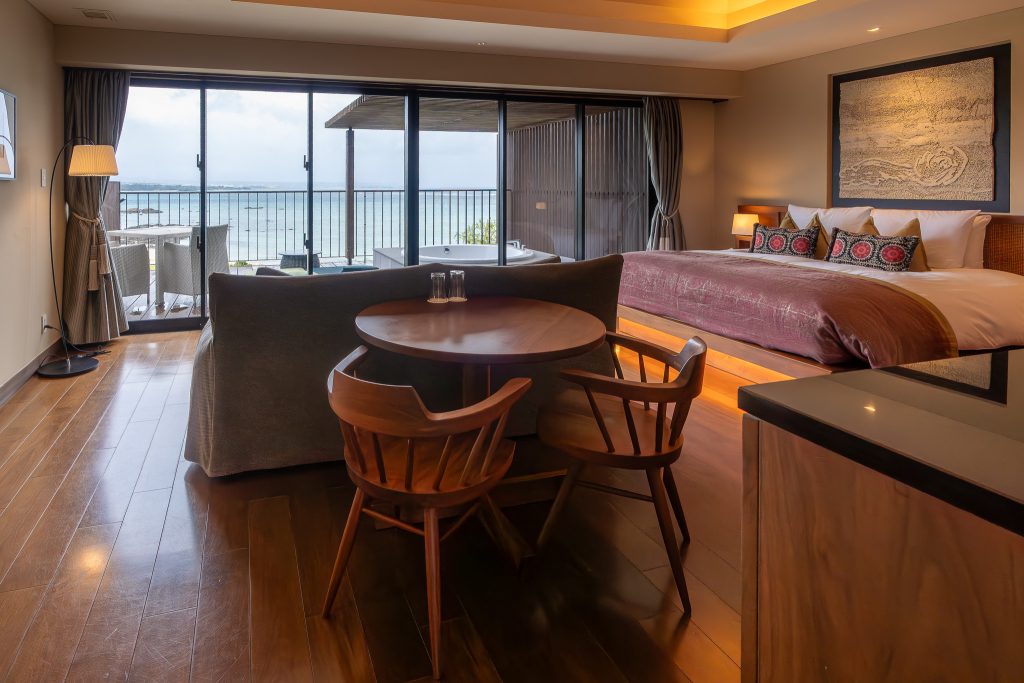
Scale is the defining operational choice: just 19 rooms in total, including five private pool villas, spread across five main categories from Private Pool Villa Suites down to Standard rooms. Every accommodation includes a terrace or balcony with cobalt-blue sea views, and each one adds an outdoor jacuzzi or jet bath, heated and sized for two, with a practical request that guests use swimwear. Terraces are equipped with dining table and chairs, an outdoor mattress, and garden furniture, so time outdoors is an integral part of the layout rather than an afterthought. Room designs vary by size, roof height, view, and artwork, with white, stone-like textured wall installations appearing as a recurring motif in both guestrooms and public spaces. For guests who want proximity to shared facilities, some ground-floor units offer direct garden and infinity pool access, while split-level Standard rooms use the sloping terrain to create distinct living zones.


Dining is the organizing principle. The on-site restaurant focuses on French cuisine that makes lavish use of Okinawan ingredients, supported by a culinary philosophy that emphasizes meeting local producers and selecting ingredients with an understanding of climate. The restaurant complex includes a large main dining room and four private dining rooms, and the property also runs a café in the reception lounge building plus room service, both framed as Okinawan-influenced alternatives for multi-night stays. Breakfast is served in the restaurant from 7:30 AM to 9:30 AM (last orders) and includes a seasonal smoothie, with the dining room designed to catch natural light through large windows. Evening extends into the Lounge Bar (5:30 PM–10:30 PM, last orders), stocked with rare kusu (aged awamori), Japanese and foreign whiskies, brandies, and cigars. Practicalities matter here: non-resident dining requires prior reservations, the restaurant asks that the table choose the same set menu, and alcoholic beverages are not served to customers planning to drive after the meal. For wellness, THE SPA KUKURU (9:00 AM–11:00 PM, last admissions 9:00 PM) builds customized programs using original oils selected in line with the phases of the moon, with advance reservations required.


The result is a boutique luxury resort that takes a clear position in the Okinawa market and aligns more closely with European-style gourmet retreats than with large-scale beach complexes. Recognition from the MICHELIN Guide Hotel Selection, including a One MICHELIN Key in 2025 held for at least two consecutive years, underlines the property’s small scale, design discipline, and restaurant-led identity. The value proposition is straightforward: premium rates buy privacy across a 19-room inventory, villas and terraces designed for long, quiet hours, and a dining program calibrated to stand alongside destination restaurants rather than typical resort outlets. Access requires deliberate planning, with complimentary transportation from Ginoza Interchange for bus arrivals, paid taxi or hired-car options from Naha Airport, on-site parking, and no dedicated airport shuttle. This is best suited to adults planning a romantic or celebration stay where meals and restorative downtime define the itinerary. Travelers who want west-coast convenience, a busier resort scene, or a schedule filled by on-site activities should look elsewhere. Within Okinawa’s resort landscape, Ginoza functions as a principled alternative for guests who prefer intimacy and cuisine over scale and spectacle.

- Best For: Upscale city stays prioritizing space, access, and views over resort sprawl
- Feel: Mid-century American design with Ryukyu-American cultural influence
- What Stands Out: Rooms over 45 m²; upper-floor pool and jacuzzi; four on-site restaurants
- What to Consider: Urban orientation over beachfront; paid parking
- In Brief: A 12-floor Naha city hotel near Kokusai Street with spacious rooms and high-floor facilities.


Southwest Grand Hotel positions itself as a skyline-focused alternative to Okinawa’s beachfront resorts, emphasizing an urban base in central Naha rather than direct beach access. The 12-floor property in Naha City, functions as a full-service city hotel within a short walk of Kokusai Street, the city’s primary shopping and entertainment artery. This location supports easy access to dining, nightlife, and transport connections while keeping the focus on city views. Naha Airport is around 12 minutes away by car, and the surrounding Kokusai Dori district operates as a practical base for exploring the wider island via public transport, organized tours, or short taxi rides to key transit hubs. The hotel’s interiors draw explicitly on mid-century American design and postwar Ryukyu-American cultural influences, integrating warm wood textures and natural materials in a way that acknowledges Naha’s international history and Okinawan character.


Rooms are central to the proposition. Southwest Grand offers five room types, from Grand Twin and Balcony Twin to Corner King, Terrace Suite, and Penthouse Suite, across a total inventory of under 100 keys, with standard rooms sized at over 45 square meters. Layouts are open and intended to feel more residential than compressed, with large windows framing downtown Naha and creating visual continuity between the interiors and the city. A Balcony Twin configuration aligns with this concept in straightforward terms: twin beds, a balcony, large windows oriented to city views, and guestroom finishes that use wood and other natural materials to establish a calm, contemporary setting. Arrival and departure are handled in line with international city-hotel expectations, including express check-in and check-out services for guests arriving by taxi or other transport. The 11th floor concentrates the primary leisure facilities, including an indoor heated pool with blue lighting, an outdoor jacuzzi, a lounge, and a guests-only coin laundry.


Dining and wellness complete the full-service profile while maintaining an urban rather than resort framework. Four on-site restaurants cover different requirements, including an all-day dining venue, a Japanese restaurant, and the teppanyaki outlet TEPPANYAKI MATSUO, alongside outlets listed as A LONG VACATION. and SHIKAKU, with reservations handled online via the hotel’s linked platforms. An upper-floor poolside dining and sunset bar further reinforces the building’s vertical orientation, using panoramic city views as a principal feature. Wellness facilities include THE SPA, also bookable through an online reservation system, and a guests-only fitness center where contemporary, wood-accented equipment mirrors the broader materials language of the hotel. Practical considerations are addressed clearly: paid parking is available on site, wheelchair accessibility is noted in tourism tags, and the official website functions in Japanese, English, Chinese, and Korean, facilitating planning and communication for international guests.

Southwest Grand Hotel is best understood as a luxury city hotel that treats Naha itself as the destination rather than simply a gateway to Okinawa’s resort coast. The value proposition rests on three elements that align with international upper-upscale standards: base-category rooms that are significantly larger than typical urban hotel norms, a coherent design identity linked to Ryukyu-American cultural history, and an upper-floor amenity program that makes effective use of the building’s height. Within the context of high-end Naha properties, the combination of generous room sizes, skyline-oriented pool and wellness facilities, and four on-site dining options supports its 5-star classification and competitive positioning. This hotel is particularly suitable for guests prioritizing Kokusai Street access, city views, and contemporary, spacious interiors, including business travelers who still expect leisure-grade facilities. Travelers whose priorities center on direct beachfront access, expansive grounds, or a traditional resort rhythm are likely to be better served by coastal properties elsewhere on the island.

- Best For: International travelers wanting a full-service beachfront resort with established standards
- Feel: Spanish colonial resort campus, mature and orderly
- What Stands Out: Multi-wing layout, consistent ocean-view positioning, broad facilities
- What to Consider: Winter Garden Pool closure, car dependence, dining costs add up
- In Brief: A long-running, 397-room (some sources cite 396) beachfront resort built for reliability over novelty.


Not every Okinawa stay needs a design story or a just-opened date stamp to justify itself. Some properties work because they have been doing the same thing, in essentially the same place, for a very long time and have learned how to do it cleanly, quietly, and at scale. Hotel Nikko Alivila Yomitan Resort Okinawa has been operating since June 27, 1994, and it reads as an established property in the most practical way: a large, full-service beachfront resort that has had time to settle into its setting. The Spanish colonial exterior, with red tiled roofs and white walls, is a deliberate identity rather than a theme applied in passing, and the campus structure matters. Instead of a single tower, rooms spread across multiple wings (North, West, South), which helps preserve a sense of space and privacy despite the scale. Landscaping has matured over more than three decades, and the overall composition, courtyards and fountains included, aligns with a resort built for repeat, multi-season use. The name “Alivila,” drawn from Spanish words for relaxation and villa, matches the hotel’s “holiday for the soul” concept without requiring guests to buy into a trendier narrative.

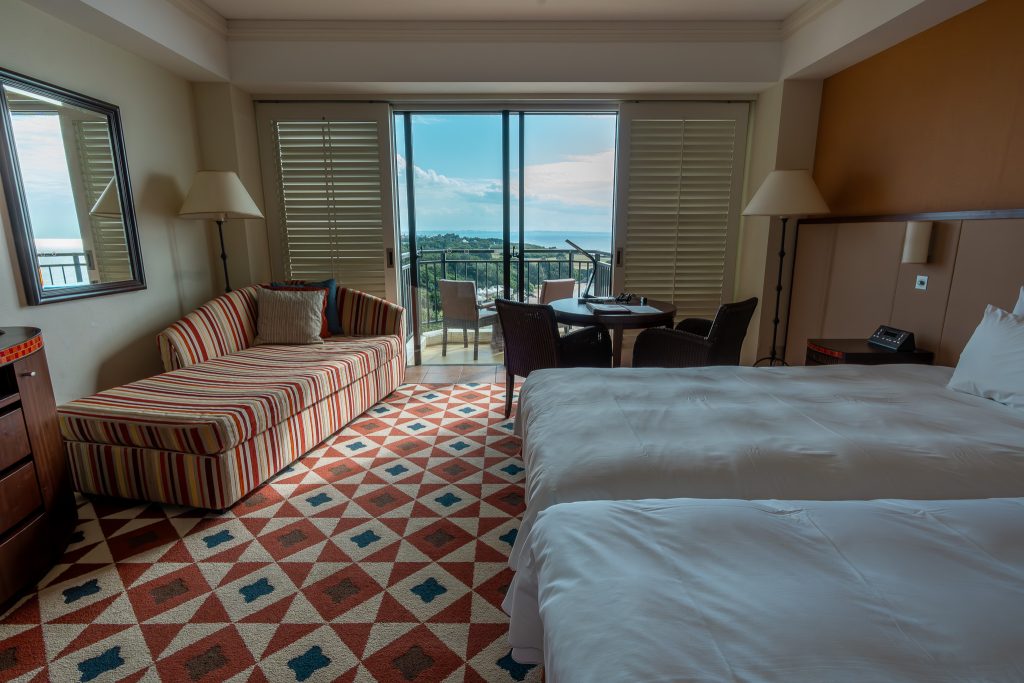
Room planning is one of the hotel’s most persuasive arguments, particularly in the Premier Ocean Patio Twin category. At around 43 square meters, it sits well above typical Japanese hotel expectations for everyday livability, while still matching the familiar template of international resort rooms built for longer stays. The essentials are consistent: twin-bed configuration, an ocean-view balcony, and a strict non-smoking policy that extends to the balcony itself. Bathrooms include both a bathtub and a separate shower, a layout that keeps mornings functional for two people and makes post-beach routines more straightforward. Storage and circulation benefit from the footprint, and the room’s breezy positioning toward the sea is part of the product, not an upgrade gamble. Minor practicalities can surface in a property of this vintage, including minibars that function more as empty refrigerators than stocked statements of luxury.


Facilities are broad, though winter timing changes how the resort should be used. The outdoor Garden Pool operates seasonally and is closed from December 1 to February 29 (with reduced hours in the wider November to March window), so winter stays shift attention to the indoor Relaxation Pool and the hotel’s spa offering, including massages, body treatments, facials, and a sauna. The beach, with direct access from the property, remains a constant; the water is often described as calm and clear, and the swimming area is frequently netted for safety, even if colder months naturally temper swim plans. Dining is positioned as an on-site ecosystem: five restaurants plus a lounge and bar. Brasserie Verdemar anchors the modern European, French-influenced lane, while Hana Hana handles the Japanese and Western buffet format that suits resort routines. Quality is generally high, but pricing can feel consequential over several meals, and in-room dining is not the most expansive option.

Value sits in the hotel’s dependable breadth rather than design novelty. With typical rates starting around ¥20,000 per person per night depending on season, Hotel Nikko Alivila occupies a mid-to-upper tier where guests should expect solid international standards, cleanliness across public areas, and a service culture that remains polite and helpful. English-speaking guests are supported, sometimes with translation apps, and the One Harmony affiliation under Nikko Hotels International and Okura Hotels & Resorts reinforces an operational model built around recognizable benefits such as quicker check-in and discounts at designated restaurants and shops. The trade-offs are mostly about logistics and priorities. Yomitan is quiet and slightly removed, about 70 minutes by car from Naha Airport, and while an airport limousine bus connects to the hotel, a rental car is the pragmatic choice for exploring; on-site parking is paid, with roughly 250 spaces and a 1,000 yen per-stay fee per car. Travelers chasing cutting-edge interiors or a walkable urban base should look elsewhere, but for a multi-generational, internationally oriented Okinawa resort that has earned its rhythm, Alivila remains a reliable call.

- Best For: Families and international travelers planning longer resort stays focused on pools, spa time, and northern Okinawa access
- Feel: Established, large-scale resort with public spaces referencing surrounding forest and sea
- What Stands Out: All rooms with ocean-view balconies from 44 m² up; large Garden Pool complex; extensive bath and sauna facilities; Club Lounge access for higher categories
- What to Consider: Around 60–70 minutes from Naha Airport with paid on-site parking; some bathrooms lack full separation of toilet, shower, and sink, which may matter for families sharing
- In Brief: A dependable northern Okinawa base between East China Sea views and the World Heritage-listed Yambaru forest region


Oriental Hotel Okinawa Resort & Spa operates as a northern Okinawa resort at the entrance to the Yambaru area, the subtropical forest region inscribed as a UNESCO natural World Heritage site in 2021. Opened in 2005 and rebranded under the Oriental Hotels & Resorts flag in 2021, it represents the brand’s first resort hotel and positions itself as a substantial, full-service base rather than a small design property. The setting in Kise, Nago City, combines elevated views over the East China Sea with easy access north into Yambaru and south toward Onna’s coastal sights, a pattern similar to other Japanese resorts that bridge leisure and regional exploration. Road access from Naha Airport is straightforward at roughly 60–70 minutes via the Okinawa Expressway, with the nearby Kyoda Interchange simplifying onward drives. Recent multi-year renovations, completed on April 23, updated the lobby, Club Lounge, Garden Pool, and rooms, with the lobby’s Yambaru greenery, environmental music, and seasonal nature-themed art signaling the regional context in an international-resort framework.

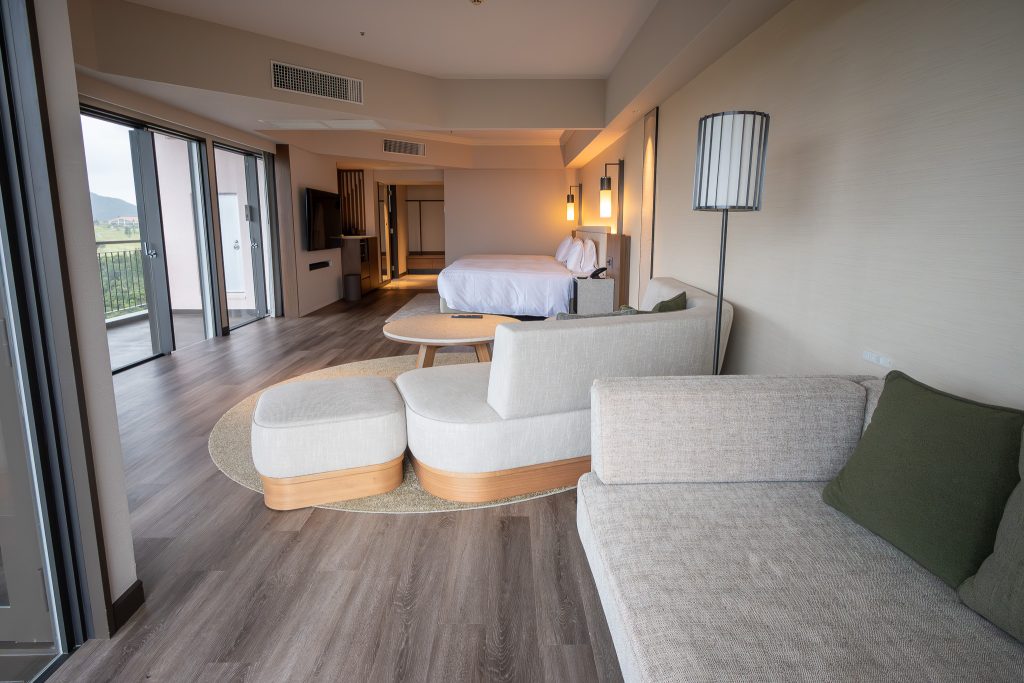
The accommodation offer is defined by scale and uniform views. All 361 guest rooms face the ocean with private balconies overlooking the East China Sea and the forested interior, and a minimum size of approximately 44 square meters, generous by Japanese resort standards and competitive globally for this category. The inventory runs from Superior Rooms, around 44–45 square meters, through higher-grade Club Rooms on the top two floors to Suite Rooms that include panoramic suites placed at the central junction of the V-shaped building for wide ocean vistas; the Royal Suite serves as the flagship. Family use is clearly anticipated, with several standard configurations accommodating up to four guests, often via twin beds plus a sofa or daybed, and many reviews noting four-bed layouts. Universal Rooms and barrier-free options support guests with mobility needs, a rarity among comparable properties. Bathrooms differ by type, with some layouts offering separated bath and toilet and others organizing toilet, shower, and sink less distinctly, an important detail for parties sharing space.


Recreation and wellness facilities are extensive and align with the resort’s base-camp positioning. The complimentary Garden Pool complex is designed for multi-hour use, with a long water slide, deep pool zone, kids’ pool, cabanas, and wide deck space oriented toward sunset over the East China Sea; operations shift seasonally, including partial heating from around March and colored lighting that enables a night-pool atmosphere with hours typically extending to roughly 21:00 or, in summer, later within published schedules. Adjacent to the pool, an assortment of saunas are available at an additional cost and are operated by a third-party provider. Additionally, an indoor heated pool operates year-round for swimming and aqua walking, while the fitness gym provides a bright, free-to-guest space with a range of equipment suited to longer stays. On the first floor, the large Japanese-style bath and spa facility offers five baths, including a Jet Bath and air-bubble Vibra Bath, a dry sauna, and an outdoor bath. It is gender-separated, requires bathing without swimwear, and operates 6:30–11:00 and 15:00–23:00 with Monday and Thursday morning closures; access is complimentary for Club Room and Suite Room guests. Supplementary facilities include a children’s playroom, coin laundry, car-sharing service, workcation-focused services such as smart check-in and an amenity base, and building-wide free Wi‑Fi.


Dining follows a broad, resort-scale model with emphasis on Okinawan ingredients. Buffet & Grill QWACHI, whose name refers to “feast” in Okinawan, serves as the main restaurant with an open kitchen and breakfast, lunch, and dinner built around Japanese, Chinese, Okinawan, and Western selections; breakfast is frequently highlighted for variety, with fresh orange juice and Okinawan ice cream such as Blue Seal among the notable offerings. Additional options include an izakaya-style venue popular with both locals and visitors, a charcoal-grill restaurant, Ryu-sen, focused on local beef, pork, and chicken, a renovated open-air Lobby Lounge for drinks and light fare, and a seasonal poolside bar. The hotel is firmly family-friendly in positioning, with policies welcoming children and a facilities mix that prioritizes pools and play space over nightlife. Pets are not accepted apart from assistance dogs, and on-site parking is available on a paid basis. Access for guests without cars is supported through recommended limousine or airport shuttle buses and the on-property car-sharing fleet for shorter excursions.

As a resort proposition in northern Okinawa, Oriental Hotel Okinawa Resort & Spa concentrates on dependable fundamentals: consistently spacious, all-ocean-view rooms; a large pool and spa offering; and a location suited to exploring both Yambaru’s World Heritage forests and coastal attractions such as Manzamo and Okinawa Churaumi Aquarium by car. In comparative terms, it aligns more closely with established family-oriented resorts in other Japanese coastal regions than with boutique properties in central Naha, emphasizing recreational breadth and international-ready infrastructure over intimacy or avant-garde design. The Club tier, with Lounge access and spa privileges for Club and Suite guests, introduces a quieter service layer familiar from major Asian resort brands and will particularly appeal to international travelers seeking clearer zoning from family activity areas. The main considerations are structural rather than operational: the 60–70 minute airport transfer, paid parking, and limited immediate off-property dining mean that stays work best for guests planning to rent a car or rely on shuttle services and to spend significant time on-site. Travelers who prioritize walkable nightlife, compact scale, or a Naha-first itinerary will find stronger fits elsewhere. Within its category, this property functions as a reliable northern Okinawa resort anchor, especially for families and international visitors who value space, comprehensive facilities, and straightforward access to Yambaru-focused experiences.

- Best For: Pool-first Okinawa stays that prioritize on-site facilities and easy access to Cape Zanpa Park and nearby beaches
- Feel: Large-scale coastal resort with a practical, facilities-led approach
- What Stands Out: 465-room inventory, beachfront positioning near Uza Beach, and a major multi-pool complex
- What to Consider: Dining skews buffet-led; the setting suits drivers more than walkable, town-based itineraries
- In Brief: A rebranded Grand Mercure resort using scale and coastal location to compete as a family-oriented Okinawa base.

If your ideal Okinawa stay is less about wandering town streets and more about orbiting between pools, sea, and parking lot day trips, this is very much that kind of place. Grand Mercure Okinawa Cape Zanpa Resort sits at 1575 Uza in Yomitan-son, on central Okinawa’s main island, where Cape Zanpa’s cliff-lined coastline defines the landscape. The property reopened under the Grand Mercure name in April 2024, following its prior life as Royal Hotel Okinawa Zanpamisaki, and the repositioning is clear in its ambition: a large, 465-room resort aimed squarely at leisure demand. It is widely characterized as beachfront, with Uza Beach only a few minutes’ walk away, and the broader Cape Zanpa Park area functions as a natural extension of the stay. The setting is also a logistical advantage for drivers, balancing north and south day trips more evenly than resorts anchored at either end of the island.

Accommodation is organized around familiar resort categories, including Superior Twin Rooms and Executive Japanese-Western Junior Twin Suites with ocean views. Higher-floor options appear in the room mix, and many rooms include balconies oriented toward sea and sunset views. The Japanese-Western suite concept, pairing tatami elements with twin beds, signals an attempt to speak to both domestic expectations and international resort norms without forcing either. Across categories, rooms are described as non-smoking and stocked for functional comfort: air conditioning, a refrigerator, tea and coffee maker, safe, wardrobe space, and a private bathroom with bidet and a bathtub or shower plus toiletries and slippers. The resort’s signature play is its outdoor pool program, presented as one of Okinawa’s larger complexes—referenced as five pools including children’s areas and water slides, operating seasonally.


Dining and wellness align with the resort’s high-capacity logic. The on-site restaurant is positioned as family-friendly, serving Japanese and Western cuisine, with breakfast and dinner most often structured as buffet service, including a mix of Okinawan and international items in the morning. This is efficient and predictable for a 465-room operation, though it also means evenings tend to revolve around the buffet rather than a broader menu of on-property choices; room service is not part of the model. For downtime beyond the pools, the resort includes a sauna and communal bathing facilities, including an open-air bath, with the standard Japanese consideration that visible tattoos may limit access to shared bathing areas. Operationally, check-in runs from 15:00 and check-out is by 11:00; free on-site parking and airport shuttle bus access support the reality that many outings require a car.

As a value proposition, Grand Mercure Okinawa Cape Zanpa Resort is best understood as a facilities-led coastal base, not a boutique hideaway. Families will find great value in its extensive water sports facilities and family-friendly atmosphere. The strongest arguments are scale and positioning: a large room inventory, direct or near-direct access to Uza Beach, proximity to Cape Zanpa Park and its lighthouse program, and a pool complex designed to occupy long resort days, with seasonal operation that typically closes between November and February. The April 2024 rebranding places the property in a more internationally legible category, and booking platforms list overall guest satisfaction in the low 8s out of 10, with cleanliness and comfort typically scoring higher. This is credible, transitional territory for a newly repositioned resort. Travelers who want varied, walkable dining and a town-centered Okinawa stay should look elsewhere. For pool-forward leisure trips that favor on-site completeness and a rugged Cape Zanpa coastline, it is an easy short-list.


